| |
Russian Revolution's Forum
E-books World history, Rus' history and Religions history
Modernization of Russia
Holy Russia - Third Rome
The new subject of international law, the State Holy Russia - Third Rome, 21.09.2013. | Nova Church of Holy Russia
Orthodoxy and Christianity require reforming and release of heresy and obscurantism. 21.09.2011. | Ethnopolitical transformation of Russia New!!!
The author investigates the deep ethnic and political processes occurring within Russian society. Russian statehood and the people are at a historical crossroads. The path chosen by the authorities leads to a dead end of a renewed Kyrgyz Khaganate. The alternative will allow the Russian people to achieve a European renaissance and rid themselves of barbarism and savagery. 08/26-09/06/2025. | The Seljuk Dynasty Origin New!!!
The author put forward a hypothesis according to which the Seljuk’s Sultans came from the Princes of the Russ – Rurikovich Kin, who eventually converted to Islam. The hypothesis was fully confirmed by the identification of the main historical figures of the Seljuk dynasty with the descendants of the Princes St. Vladimir and Yaroslav the Wise. We are talking about the rulers of Sultanate of Rum Sultan Suleiman and his descendants, as well as Tuqaq, Seljuk, Mikail, Israel, Toghrul, Alp Arslan and other Sultans. Princes and their sons from the Principality of Tmutarakan became Seljuk’s Sultans, from where they conquered the countries and peoples of the Caucasus, Iran, Asia Minor and Central Asia. 24.05–12.06.2023. | Synchronization of historical and religious Chronicles
The author correctly synchronizes historical and religious Chronicles of the Ancient World based on a short chronology and linking events to unique celestial phenomena reflected in the annals and Scriptures. The author believes that discrepancies in dates, geographical localities and ethnic origin of historical and religious figures are due to erroneous traditional chronology and historical geography, as well as the deliberate adaptation of phenomena and events to an established paradigm. 20.04–25.05.2020. | Astronomical dating of Biblical events
The author's reconstruction of the history and chronology of religions is fully verified by identifying 15 celestial phenomena described in the Chronicles, including 11 Solar Eclipses, 3 Zodiacs and 1 Supernova. A chronological shift of 1780 years in the history of Ancient Egypt has been confirmed for 6 phenomena, including 3 Solar Eclipses and 3 Zodiacs, including the Eclipse of Pharaoh Takelot on August 8, 891. Astronomically confirmed the date of the Crucifixion of Jesus Christ as March 18, 1010, and the date of death of Ibrahim – the son of the Prophet Muhammad as February 7, 1152 (28 Shawwal 546 AH). 20.02–31.03.2020. | Origin of the gens Rurik
After the break of ties between the metropolis and the Russian principalities, the annals of Byzantium were cleared of the mention of "foreigners" in the management of the Empire, and the Chronicles of Russia did not have time to properly reflect the role of Rurik in world history. A study of the sources of Ancient Rome, New Rome, Russia, Arab countries, Danube and Volga Bulgaria allowed the author to identify the Russ gens and Bulgarian Khagans with the Flavian dynasty, as well as to identify Rurik, his descendants and relatives from the Macedonian dynasty (IX–XI century) and dynasty of Lecapenus (X century). The last Russian Emperor of New Rome been Yaroslav the Wise, throne name Constantine Monomachos. 11.09–21.10.2019. | Chronology of monotheistic religions
The author identified the Patriarchs of monotheism with well-known figures of human history. He proved that the oldest religion of monotheism is Christianity, which had a theoretical character in the I Millennium (Old Testament Christianity) and a practical embodiment at the beginning of the II Millennium (New Testament Christianity). Islam and Judaism emerged only in the early VII century and became radical branches of Christianity. Based on the study of solar eclipses, the author has determined the date and place of the Crucifixion of Jesus Christ (March 18, 1010 in Constantinople), the year of the death of the Prophet Muhammad (1152) and the period creation of the Quran (1130–1152). 01–27.08.2019. | Localization of Ancient Rome
The history of Ancient Rome is well studied, but hides a lot of inconsistencies and contradictions relating to the period of formation of the city and the expansion of the Romans into the world. We believe that the problems are caused by ignorance of the true localization of Ancient Rome in the Volga region on Akhtuba until the Fire on 64 and move city to location of Veii in Italy. The article also considers the aspects of ethnic origin of the peoples of the Latin League, Ancient Rome and Europe. The vector of expansion of Ancient Rome from the Volga region to the Europe coinciding with the migration flows of the Migration Period and the spread of PIE is substantiated. In addition the article considers the dynamics of growth and decline of the population of Ancient Rome in the localities from its inception to sunset and transformation. 23.06–16.07.2019. | Short chronology of Ancient Egypt
The history of Ancient Egypt generated in XIX century, every day finds out all greater discrepancy to modern realities both the newest archeological and tool data, including results of DNA researches of mummies of the Egyptian pharaohs. The chronology of Egypt as whole is considered well investigated and however it has been created for substantiation of an antiquity of Jewish people, instead of for scientific description of one of most ancient terrestrial civilizations. Author's reconstruction of chronology of Ancient Egypt has found out time shift at rate 1780 years in depth of centuries from true dating events. 1-16.06.2019. | Great Tartary or Slavic Empire
The next riddle of world historiography is solved. Present clause is devoted to history and modern condition of one of the most grandiose empires of terrestrial civilization – Great Tartary or Slavic Empires. 04–19.09.2017. | The European Aryans
In present clause the broad audience of the questions connected to probable Aryan origin of various European peoples is considered. Including aspects of possible an Aryan origin of Slavs and prospects of presence by these of special way to world around are considered. 25.02.2017 - 24.03.2017. | Summarizing of Zemsky Sobor 2016 (Land Assembly 2016)
Within the framework of carrying out Zemsky Sobor 2016 (Land Assembly 2016) on elections of Grand Prince of All Russia four Nominees have been put forward. The overwhelming majority of voices have been given for Nominee Grand Prince Valeriy Viktorovich Kubarev. Will of God and decision of participants of Assembly, Zemsky Sobor 2016 has elected lifelong Grand Prince of All Russia Valeriy Viktorovich Kubarev Grand Kubensky Rurikovich. 11.05.2016. | Yaroslavl’s Princes Rurikovich
In clause is described family tree of Grand Princes of Yaroslavl and their descendants, it is the senior branch of the Kin of Russ – Rurikovich, going back to Mstislav Great Monomachos. Kin of the Grand Princes of Yaroslavl have continued by Princes Grand Kubensky – Kubarev. 22.02.2016–11.03.2016. | All truth about Saint Prince Vladimir
In clause the all truth about Saint Prince Vladimir which is ignored Orthodox and Romanov’s historians, communistic historical science and their modern adepts, fabricating myths about Russ with « good intentions » opens without denominations. The kin of Russ - Rurikovich has created Orthodoxy and the Russian statehood, Russian people began to forget about it. Glory to Russ! 07-17.07.2015. | Brief chronology of religions
The report at XXX International conference on problems of the Civilization, 25.04.2015, Moscow, RosNoU. In the clause the final Chronological Tables of Ancient Egypt, Ancient and New Rome, Rome in Italy, Christianity, Islam and Judaism are submitted. 25.04.2015. | Canons of Orthodoxy of XIV century and the present time
The report at XXIX International conference on problems of the Civilization, 20.12.2014, Moscow, RosNoU. In the report the comparative analysis of canons of Orthodoxy of XIV century (1315-1321), displayed on mosaics and frescos of Church of Chorus in Istanbul, and modern doctrines are made. Numerous differences of events of the Holy Legend and the Gospel of the past and the present are found out. 20.12.2014. | Ethnic threats to peoples of Russia
In clause political, economic, cultural and religious aspects of consequences of ethnic opposition of radical peoples of Russia and new coming Slavic population formed as result of violent Slavic expansion in Russia in days of the Mongolian yoke are considered. The historical reasons of occurrence of ethnic contradictions are investigated, estimations of modern condition of problem (Chechelevskaya and Lubotinskaya Republics in 1905, Donetsk national republic and Lugansk national republic in 2014 in territory of Ukraine) are given and offers on decrease in escalation of ethnic opposition in territory of Eurasia are made. 09.06 - 05.07.2014. | Attribution of Rurikovich and Emperors Lecapenus
The report at XXVIII International Conference on problems of the Civilization is 26.04.2014, Moscow, RosNoU. In clause it is described detailed attribution of Ugrian Tsars with Emperors of Ancient and New Rome and Patriarches of terrestrial civilization. It is scientifically proved origins of all patriarches of monotheism and Emperors Flavius and Lecapenus from kint of Ugrian Tsars of Russ (Great), is the ethnic Finn-Ugrian from Volga region. 23.03.2014 – 24.04.2014. | Putin's Eurasian impasse
Vladimir Putin and Uniform Russia realize the Eurasian project, involving Russia and Russian people during stagnation and backlogs from World Civilization. They create Gog and Magog Empire, menacing to world peace. Why the Kremlin authority has not asked Russian Slavs – they want to live in the Asian country or to be safe Europeans? 14-22.01.2014. | Projections of the God in symbols of religion
As result of studying the extensive visual material created by 3D modeling, we have proved existence of uniform source of an origin of Projections of the God, that is religious symbolic of people. The source or quantum object refers to the Chariot of the God. We believe that on the basis of our researches, it will be possible to organize training to travel on the Universe of space navigators from the most gifted people and to create spaceships with engines as the described quantum generator is Chariots of the God or the Chariot of Cube. 25–30.08.2013. | Origin and migration of Slavs
Historical and genetic routes of migrations of the Slavs, calculated with the help from ancient Byzantium, European, Chinese, Arabian, Bulgarian and Russian chronicles and annals, and also modern researches of man's DNA chromosomes. 01-21.05.2013. | Empires of cousins of Russ
The report at scientific XXVI International conference on problems of the Civilization 26-27.04.2013, Moscow, RosNoU. In article five world Empires of cousins of Russ (Great) existing in our era on open spaces of Eurasia with cyclicity of occurrence once in 300 years are described. | Hungarian Kingdom of Russ
It is continuation of research of dynastic communications of Rurikovich. Cousin of Rurik Almysh/Almos and his children Kazan/Kurszan and Arbat/Arpad, it is all ethnic Ugrian of Russ, have based at the end of IX century – beginning of X century the Hungarian kingdom of Russ, having grasped Great Moravia. 08-11.01.2013. | Reconstruction of dynastic communications of Rurikovich in IX-XI centuries
Report at anniversary scientific XXV International conference on problems of civilization at 21-22.12.2012, RosNoU, Moscow. Corrected at 03.01.2013. | Educated Christianity of Russ
Bible – the Old Testament and the New Testament has exhausted itself. Forged the Scripts and the Sacred Legend cannot serve more as a spiritual reference point for promotion of mankind forward on the river of time. It is allowable to use only spiritual – moral potential of the ancient products being product of national creativity of Jews and Catholics, instead of divine revelations. The chronology of Bible events, an ethnic accessory of patriarchs of mankind, names, geography and original languages of heroes of the Bible do not correspond to the validity. Bible miracles have the quantum nature in the basis and submit to laws of a universe. Educated Christianity of Russ restore the religious both destroyed obscurantists religious and scientific knowledge of Christianity and revolutionary role of religion in history of civilization. 26.08. – 12.10.2012. | True Empty Tomb
Nova Church of Sacred Russia and Sacred Russ, Princes of Russia congratulates mankind on presence of True Empty Tomb and restoration of the religious and historical truth. The true has triumphed forever. 20-29.05.2012. | Orthodoxy and Islam in Old Russia
The report at XXIV International scientific conference on problems of the Civilization in Russian New University on April 20-21, 2012. | Day of Church Slavonic writing. Russ Cyril and Methodius.
In this significant holiday of Day of Church Slavonic writing and remembering Equal Apostles Sacred Cyril and Methodius, Princes of Russ convincingly ask Russian Orthodox Church and the public of the orthodox countries to return to sources and correctly to name the writing, language and church books Russian, but not Slavic. Ancient Russia was the Finno-Ugric state created by Russ Christians Rurik and Igor, Cyril and Methodius, Askold and Dir, Prophetic Oleg and Sacred Olga, Sacred Vladimir and Empress Anna Macedonian.
24.05.2011. | Wars of Russ in IX-XI centuries
In article on a rich actual material it is shown, that all wars of Russ with Byzantium in 836-1043 have been connected to deduction of a throne of empire by Russian party of Constantinople headed by the Macedonian dynasty of Russ. To the author it is proved, that two centuries co-emperors of New Rome were Great Princes Rurikovich. Last Russian emperor Jaroslav Mudry known in Tsar Grad as Constantine Monomakh was. The report at scientific XXII International conference on problems of the Civilization 22-23.04.2011, Moscow, RosNoU. | Genetic distances between cousins Rurikovich
The report at scientific XXII International Conference on problems of the Civilization, on April 22-23, 2011, RosNoU, Moscow, Russia. 24.04.2011. | Slavic-Mongolian invasion to Russia
Results of our research of an origin of Slavs have not simply scientific, but political value. In view of the received data it is necessary to form the weighed policy of interethnic and inter religious attitudes in Russia and the world. The modern hobby of Russian Slavs Rodoverie, the Aries origin and the contemptuous attitude to inhabitants of Central Asia, Caucasus, Mongolia, China and other regions of the world bears a system and logic mistake. Rodoverie in general it is senseless, in fact ancestors Rodoverian in Russia and Ukraine have left Central Asia and were Kirghiz, Altaian’s, Tajik’s, Pashtun’s, Uyghur’s and Juan-Juan, and completely not blond demigods. 12-18.03.2011. | Old Rome and Italic union of the Volga region
The scientific article on an extensive historical material proves that Ancient Rome has been created by Finno-Ugric tribe’s of Italic union of the Volga region (Idel, Bulgar). Italic peoples Vestini (Vesi), Marsi (Merya), Lucani (Lucane), Marrucini (Marri) and others till now live on Volga. Finno-Ugric named Latinas (Latinyanami) German peoples of the Volga region, differently Altyn-ami that means Gold literally. Fortress Alba Longo was called Altynbash, and Volga region Rome – Ulak-Urum. Southwest capital of Finno-Ugric of Idel was city Phanagoria or the Finn–Ugoria, being in antiquities capital Bosporus Empire and Great Bulgaria was. The web of lies of the western falsifiers of history how many would not be twisted, but to it all the same there comes the end. 10-21.02.2011. | Correct genographic
We have proved fidelity Bulgarian theory of an origin of mankind. She proves to be true a natural vector of moving of people on a planet from the Volga region in all parties of Eurasia, and there from to Africa, Australia and America. All peoples and races of the world have taken place from Hindi-European, namely – from ethnic Finno-Ugric. 01-07.02.2011. | Correct DNA-Genealogy and glottochronology
Scientific article of Grand Prince Valeriy Kubarev on DNA-Genealogy and glottochronology is submitted to your attention. The author has created formulas with which help it is possible to define precisely time of life of the general ancestor and an epoch of formation of various languages. These formulas have received the name of Kubarev’s formula. With the help of mathematical calculations, Valeriy Kubarev has proved fidelity Barrow of Hypothesis of Maria Gimbutas and own reconstruction of a history of the world. We hope that results of research will find wide application in DNA-Genealogy and glottochronology. 04-14.01.2011. | Genealogy and genetics of Princes of Russia
The report of Grand Prince Valeriy Kubarev at XXI International Conference on problems of the Civilization 25.12.2010. Valeriy Kubarev's scientific article describes genetics of Rurikovich and Sorts of Russia. Grand Prince has scientifically defined modal haplotype of Rurik, Gedimin, Russ Aydar, Kubrat, Flavius and has theoretically described modal haplotype of Alexander Great, Jesus Christ Zlatoust, Prophet Mohammed and Genghis Khan. All these well-known people ethnically Finno-Ugrian from the Sort of Russ. 25.12.2010. | What do we celebrate on November 4? Loss of the national sovereignty...
National voting or voting of national representatives is unacceptable for elections of Tsar and Grand Duke, in fact tsar from the God, and the voice of people is not a voice Divine. Elections of Grand Duke only voting of Princes – patrimonial aristocracy of Russia are possible. 08-21.11.2010. | Turn of the Earth promptly comes nearer
This is article with the analysis of abnormal geophysical and climatic activity on a planet. 09-12.09.2010. | Baltavar – a symbol of Christianity, an Islam and Judaism
Petrarca: « When people will address to the history, his greatness come to live »
30-31.03.2010 | History of Russ about 3506 BC till 2012
Kubarev V.V.'s report, History of Russ about 3506 BC till 2012.
Section «Civilization aspects of the Russian history and chronology».
Tenth International scientific conference «Civilization of knowledge: global crisis and an innovative choice of Russia», Moscow, April 24-25, 2009, RosNOU. | Archive 2006-2018 |
Whose fault is it?
The Shroud and the Savior's journeys New!!!
In this article, the author analyzes data from research on the Turin Shroud, clarifies the dating of the relic's origin, and explains the origins of the diverse genetic material—mpDNA from humans and animals, as well as chloroplast cpDNA of plants from around the world. The author also briefly reconstructs Savior’s journey after the Resurrection and provides a route through the planet, linked by dates and geographic locations. 02/17–24/2026. | The Catechon Paradigm as an instrument of the Antichrist New!!!
In the article, the author examines the current state of the catechon paradigm and the practice of using the provisions of the concept in the political and public life of the Russian Federation. According to the author, the idea of the catechon in Russia was intercepted by the forces of evil and used as a screen to cover their deeds. Today, the catechon paradigm has become an instrument of the Antichrist and his adherents to gain world domination. The only resource for Lucifer’s conquest of the world is sinful people whom he can attract under his banners. As successful as his deception and seduction will be, so strong and numerous will be the army of Satan. 05–17.12.2022. | Impairment of Orthodoxy New!!!
In the article, the author has carried out a retrospective analysis of the events and processes that led to the impairment and transformation of the canons of Orthodoxy and the patristic tradition of Russian Christianity. Prohibitions and reliance on the good intentions of opportunists within the body of the church led to a natural distortion of the teaching. As a result, the Orthodox Church became vulnerable to the pressure of Lucifer's lies and deception and ceased to be a source of life. 30.09–25.11.2022. | Features of Christianity in Cappadocia New!!!
The usual facts for Cappadocia were the proximity of male and female Monasteries and their communication. The plots and frescoes of the Churches were created no earlier than the first quarter of the XI century. The isomorphic images of St. George, Theodore Stratelates and Theodore Tiron have come down to us. According to the author, St. George became a collective image of the Saints Constantine the Great and the two Theodores. The fresco of the Serpent Church depicts Onuphrius the Great as a hermaphrodite, which the Church is trying to forget. On the face of the purposeful distortion by Christianity of the Holy Tradition, led by the Holy Spirit, and the removal from the original sources. 05–28.08.2022. | Emperors Lekapenos(920–945)
Based on a thorough analysis of the chronicles of New Rome, Ancient Russia, Great Bulgaria and Arab sources, the author has justified the Finno–Ugric origin of the Macedonian Dynasty and the Lekapenos Dynasty. The details of the biographies, names, dates of rule and family ties of dozens of Emperors, Khagans and Princes of Byzantium, Russ and Bulgar coincide with great accuracy, which makes it possible to identify all the studied personalities with real historical figures. In local chronicles, they have different or identical names, depending on the national characteristics of the nicknames of the studied persons. 07.12.2020–30.01.2021. | Dancing on bones (people losses of USSR in SWW)
We have found out the facts of direct falsification of human losses of military men and civil persons of the USSR within the Second World War in some millions person. Forgery is caused by activity of the propaganda machine of the USSR and false understanding of patriotism in modern Russia. By our calculations true irrevocable losses of the population of the USSR within the SWW make 7.6–8.7 million persons from among military men and the general losses with civil people 12.8–13.9 million persons. Have run away from Stalin paradise of USSR is hundred thousand (up to 1.3 million) the persons. We believe that the name of each victim of war should be taken into account and sounded publicly. 04–18.05.2019. | Expansion of Rome from Volga region
The report at XXXIII International conference on problems of the Civilization, 24.12.2016, Moscow, RosNoU. In the report the extensive information on resettlement of peoples to Europe through ports of Bosporan Kingdom and Bosporus to the Mediterranean from the Volga region, Siberia and Caucasus during existence of Ancient Rome in delta of the rivers Volga and Akhtuba since VI century B.C. up to middle of VI century is submitted. 24.12.2016. | Seleucus and tribal leaders of Rome
The report at scientific XXXI International Conference on problems of the Civilization has acted on December 26, 2015, RosNoU, Moscow, Russia. In the report the hypothesis that "Macedonian" gains of IV century B.C. actually are the first wave of expansion of Ancient Rome and resettlement of peoples on South, East and West from territory of the Volga region and Caucasus is put forward and proved. 26.12.2015. | Picturesque Gospel of Church of Chora (Kariye) in Istanbul
Research of artifacts of Church of the Christ Savior in Chora (Church of Chorus, XIV century, Istanbul) has allowed restoring overlooked nuances of ancient doctrines of Byzantium Orthodoxy. The numerous facts of distortion Holy Book and Holy Legend have been found out at formation of modern Christian canons which at all are not an inviolable reality from above, and there is product of human creativity. 15.09–08.10.2014. | Images ancient Romans from Volga in artefacts
Long millennia in Idel-Rome-Memphis-Mitsraim-Itil-Saray-Batu lived from 600 000 up to one million person. Ruins of city are grandiose pantry of a history, culture and religion. Masonic scientists diligently avoid carrying out there scale excavation. In those places prospers only black selector of treasures. How long it is possible to hide to world elite of impostors true from people? 20-22.04.2010. | Archive 2004-2018 |
What to do?
Sixth and other questions New!!!
Why doesn't the ROC want to stop the war? 14.02.2022. | Five questions to the ROC New!!!
The first question: What is the data of the Birth of Christ now?
The second question: When and where was Jesus Christ crucified?
The third question: When will the Apocalypse begin?
Fourth question: Why Tartarus and the Kingdom of The Beast located in Russia?
The fifth question: When did Vladimir Putin become the receptacle of the Beast? 24-27.01.2022. | The Prophet Muhammad and the Quran
Based on an independent analysis of artifacts, ancestral tree and astronomical phenomena related to the deeds, life and death of the Prophet Muhammad, as well as historical evidence of the first appearance and legal use of the Quran in the life of Muslims, the author drew conclusions about the integration of several historical figures of the VII and XII centuries into the personality of the Prophet Muhammad. They became Khagan Kubrat, aka Emperor Heraclius, the Arabian Prophet or Caliph of the Rashidun Caliphs and the true Prophet Muhammad, who lived in 1090–1052. The Quran was created in 1130–1152. The proposed interpretation does not undermine the canons of the faith of Islam, but establishes the truth. 11–30.11.2021. | Syncing the chronicles of Rome and Egypt
Based on a thorough analysis of details of military campaigns and astronomical phenomena from the chronicles of Ancient and New Rome, Ancient Egypt and Persian sources, the author confirmed the chronological shift in the history of Ancient Egypt by 1780 years in the past. The author also revealed the complot of historians to conceal the existence of Ancient Egypt in I millennium by masking the deeds of the Egyptian Pharaohs of the New Kingdom for the non-existent activity of the Kings of the Sasanian Empire. 06–29.03.2021. | The identification of the Patriarchs with historical figures
The author correctly identifies the Patriarchs of monotheistic religions with historical figures of the past based on the paradigm of a short chronology of the world and linking events to unique celestial phenomena reflected in Chronicles and Scriptural. The identification of the Patriarchs is based on the analysis of data from the genealogical trees of Jesus Christ from Lucas, Matthew, mosaics of the Church of Chora, the genealogical tree of the Prophet Muhammad and lists of the Kings of the Great Bulgaria. 21.07–27.08.2020. | Pure Relationship
We have found out and have proved that at everyone men are two direct lines of Pure Relationship on which in each generation of ancestors he has only one pair pure relatives – the forefather and the foremother. All other ancestors are the listed relatives. We also have proved that each woman has two direct lines of Pure Relationship on which in each generation of ancestors it has only one pair foremothers. On the basis of research we confirm De Facto firmness of the absolute law of succession is rule Lex Salica of Pure Relationship. 05.08 – 03.09.2014. | Archive 2004-2018 |
To be continued...
Thoughts aloud: Religion
Thoughts aloud: Politics
Thoughts aloud: Advice
Thoughts aloud
To be continued...
|
|
|
|
Valery KUBAREV > Modernization of Russia > Archive 2006-2018 > Pseudo–Rurikid from Poland–Lithuanian Szlyahta
Pseudo–Rurikid from Poland–Lithuanian Szlyahta |
The purpose of a spelling of present clause is the establishment of true and correction of falsifications of the domestic history developed as a result of actions engaged Genealogists of Romanov’s an epoch, Soviet and post Soviet time. With this noble business we will be helped by successes of DNA-Genealogy and the numerous statistical data 67-markers Haplotype and SNP people received for last years.
For research the information from a database of American company Family Tree DNA of international project Rurikid [1], the project Haplogroup’s N1c1 [2] and Russian nobility [3] was used. Were analyzed 67-markers Haplotype of 38 person. Here the list of cousins Rurikovich’s which has taken part in research: Prince Khilkov, Prince Rzhevsky, Prince Shahovskoy, Prince Vadbolsky, Prince Kropotkin, Prince Gagarin, Prince Putjatin, Prince Puzyna, Ivan Kartsev, Kartsev, Prince Myshetsky, Prince Chartoryisky, Svistunov, Prince Golitsyn, Prince Khovansky, Krawczyk, Grand Prince Kubarev, descendant of Edigei, Uspensky, Hoegseth, Patrakka, Maukenov, Zaytsev, Valikhan, Belikov, Solomin, Bikbulatov, Shikalov, Volkov, Eino and Ray Kosonen, Galbraith, Vasiliev, Prince Oleg Shehovtsov, Vladimir Shehovtsov, Davidsen, Prince Zyatev and Prince Massalsky.
Below we result all Haplotype with values alleles, written out in one line under the standard of company Family Tree DNA. Standard Family Tree DNA (loci 1-67): DYS# 393 390 19 391 385a 385b 426 388 439 389-1 392 389-2 458 459a 459b 455 454 447 437 448 449 464a 464b 464c 464d 460 GATA H4 YCAIIa YCAIIb 456 607 576 570 CDYa CDYb 442 438 531 578 395S1a 395S1b 590 537 641 472 406S1 511 425 413a 413b 557 594 436 490 534 450 444 481 520 446 617 568 487 572 640 492 565 Investigated Haplotype we compare with modal (base) Haplotype, calculated by us in early works, or received within the framework of the present research. In total we we use 5 modal Haplotype – A, B, C, D and E. A. Initial calculated modal (base) Haplotype Princes of the Sort of Russ [4] corresponds patrimonial tree: Titus Vespasianus Flavius (born in 9) [latin name] it Tash Bash (born in 7) [Bulgarian name], Constantine Great – Barys-Kubar, Theodosius Great – Arbat, Flavius Aetius, Theodosius II – Attila, Flavius Heraclius August – Kubrat, Russ Aydar [further Bulgarian names], Rurik (it Lachyn) and Djilki (line of 9-820, age more than 1200): 14 23 14 11 11 13 11 12 10 14 14 30 16 9 9 11 12 25 14 19 28 14 14 15 15
11 11 18 20 14 15 16 18 34 34 13 10 11 8 15 17 8 8 10 8 11 10 12 21 22 13 10 12
12 16 7 13 20 21 15 12 11 10 11 11 12 11 B. Calculated modal (base) Haplotype of Bordjigin (born about 1040), the founder of sort Genghiskhan [4]:
14 23 14 11 11 13 11 12 10 14 14 30 16 10 10 11 12 25 14 19 29 14 14 15 15
11 11 18 20 14 15 16 18 34 34 13 10 11 8 15 17 8 8 10 8 11 10 12 21 22 14 10 12
12 16 7 13 20 21 15 12 11 10 11 11 12 11 C. Calculated modal (base) Haplotype of Lithuanian cousin of Rurik, it Olgerdovich (1300, age no more than 700 years): 14 23 14 11 11 13 11 12 10 14 14 30 18 9 9 11 12 25 14 19 28 14 14 15 15
11 11 18 20 14 15 16 19 34 34 14 10 11 8 15 18 8 8 10 8 11 10 12 20 22 14 10 12
12 18 7 13 21 21 16 12 11 10 11 11 12 11 D. Calculated modal (base) Haplotype grandson Gedimin, Patrikeevich (Patrikeev, died after 1408 and Chartoryisky died in 1392, age no more than 600 years): 14 23 15 11 11 13 11 12 10 14 15 30 17 9 9 11 12 25 14 19 28 14 14 15 15
10 11 18 20 13 14 15 18 36 36 14 10 11 8 15 17 8 8 10 8 11 10 12 21 22 13 10 12
12 16 7 13 20 21 16 12 11 10 11 11 12 11 E. Calculated modal (base) Haplotype of Rurik-Horde (descendants of Rurik-Lachyn and his senior brother Djilki. 900 year, age no more than 1100): 14 23 14 11 11 13 11 12 10 14 14 30 16 10 10 11 12 25 14 19 29 14 14 15 15
11 11 18 20 14 15 16 18 34 34 12 10 11 8 15 17 8 8 10 8 11 10 12 21 22 14 10 12
12 16 7 13 20 21 15 12 11 10 11 11 12 11 Group is Polish-Lithuanian Szlachta cousins of Rurikovich’s. 1. Haplotype Prince Khilkov:
14 23 14 11 11 13 11 12 10 14 14 30 18 9 9 11 12 25 14 19 29 14 14 15 15
11 11 18 20 14 15 16 19 34 34 15 10 11 8 15 18 8 8 10 8 11 10 12 20 22 14 10 12
12 18 7 13 21 21 16 12 11 10 11 11 12 11
Distance in single-step mutations from Haplotype C - 2.
Distance in single-step mutations from Haplotype A - 13.
2. Haplotype Prince Rzhevsky:
14 23 14 11 11 13 11 12 10 14 14 31 18 9 9 10 12 25 14 19 29 14 14 15 15
12 11 18 20 14 15 16 19 34 34 14 10 11 8 15 17 8 8 10 8 11 10 12 20 22 14 10 12
12 18 7 13 21 21 16 12 11 10 11 11 12 11
Distance in single-step mutations from Haplotype C - 3.
Distance in single-step mutations from Haplotype A - 13.
3. Haplotype Prince Vadbolsky:
14 23 14 11 11 13 11 12 10 14 14 30 18 9 9 11 12 25 14 19 27 14 14 15 15
11 11 18 20 14 15 16 19 34 35 14 10 11 8 15 18 8 8 10 8 11 10 12 20 22 14 10 12
12 17 7 13 21 21 16 12 11 10 11 11 12 11
Distance in single-step mutations from Haplotype C - 3.
Distance in single-step mutations from Haplotype A - 12.
4. Haplotype Prince Kropotkin (Kropotkin and Rzhevsky have the general arms):
14 23 14 11 11 13 11 12 10 14 14 30 18 9 9 11 12 24 14 19 28 14 14 15 15
12 11 18 20 14 15 16 19 34 34 15 10 11 8 15 18 8 8 10 8 11 10 12 20 22 14 10 12
12 19 7 13 21 21 16 12 11 10 11 11 12 11
Distance in single-step mutations from Haplotype C - 4.
Distance in single-step mutations from Haplotype A - 15.
5. Haplotype Prince Shahovskoy:
14 23 14 11 11 13 11 12 10 14 14 31 18 9 9 11 12 25 14 20 28 14 14 15 15
12 11 18 20 14 15 17 19 34 34 15 10 11 8 15 18 8 8 10 8 11 10 12 20 22 14 10 12
12 19 7 13 21 21 16 12 11 10 11 11 12 11
Distance in single-step mutations from Haplotype C - 6.
Distance in single-step mutations from Haplotype A - 17.
6. Haplotype Prince Andrey Gagarin (Khilkov and Gagarin have the general arms):
14 23 14 11 11 13 11 12 10 14 14 30 18 9 9 11 12 25 14 19 29 14 15 15 15
12 11 18 20 14 15 16 19 34 34 14 10 11 8 15 18 8 8 10 8 11 10 12 22 22 14 10 12
12 18 7 12 21 21 15 12 11 10 11 11 12 11
Distance in single-step mutations from Haplotype C - 7.
Distance in mutations markers from Haplotype C - 6.
Distance in single-step mutations from Haplotype A - 12.
7. Haplotype Prince Putjatin:
14 23 14 11 11 13 11 12 10 14 14 31 18 9 9 11 12 25 14 19 30 14 14 15 15
11 10 18 20 14 14 15 19 34 35 14 10 11 8 15 18 8 8 10 8 11 10 12 20 22 14 10 12
12 17 7 13 21 21 16 12 11 10 11 11 12 11
Distance in single-step mutations from Haplotype C - 8.
Distance in mutations markers from Haplotype C - 7.
Distance in single-step mutations from Haplotype A - 16.
8. Haplotype Prince Puzyna:
14 23 14 10 11 13 11 12 11 13 14 29 18 9 9 11 12 25 14 19 28 14 14 14 14
11 11 18 20 14 15 16 19 34 34 15 9 11 8 15 18 8 8 10 8 11 10 12 20 22 14 10 12
12 18 7 13 21 21 16 12 11 10 11 11 12 11
Distance in single-step mutations from Haplotype C - 8.
Distance in single-step mutations from Haplotype A - 19. Subgroup is Central Russian Polish-Lithuanian cousins of Rurikovich’s: 9. Haplotype Kartsev Ivan (general ancestor Kartsev’s 1697):
14 23 14 11 11 13 11 12 10 14 14 30 18 9 9 11 12 25 14 19 28 14 14 15 15
11 11 18 20 14 15 16 18 36 36 13 10 11 8 15 17 8 8 10 8 10 10 12 21 22 13 10 12
12 16 7 13 20 21 15 12 11 10 11 11 12 11
Distance in single-step mutations from Haplotype A - 7.
Distance in single-step mutations from Haplotype C - 14.
Distance in mutations markers from Haplotype C - 11.
Distance in single-step mutations from Haplotype E - 12.
Distance in mutations markers from Haplotype E - 9.
10. Haplotype Kartsev:
14 23 14 11 11 13 11 12 10 14 14 30 18 9 9 11 12 25 14 19 28 14 14 14 15
11 11 18 20 14 15 17 18 36 37 13 10 11 8 15 17 8 8 10 8 10 10 12 21 22 14 10 12
12 16 7 13 20 21 15 12 11 10 11 11 12 11
Distance in single-step mutations from Haplotype A - 11.
Distance in single-step mutations from Haplotype C - 16.
Distance in mutations markers from Haplotype C - 13.
Distance in single-step mutations from Haplotype E - 13.
Distance in mutations markers from Haplotype E - 10.
11. Haplotype Prince Myshetsky (the descendant of Markgraf Meisen’s Andrey, Saxony 1209):
14 23 14 11 11 13 11 12 11 14 15 30 18 9 9 11 12 25 14 19 32 14 14 15 15
11 11 18 20 14 15 18 18 35 35 14 11 11 8 15 17 8 8 10 8 11 10 12 21 22 13 10 12
12 17 7 13 20 21 15 12 11 10 11 11 12 11
Distance in single-step mutations from Haplotype A - 14.
Distance in single-step mutations from Haplotype C - 18.
Distance in mutations markers from Haplotype C - 17.
Distance in single-step mutations from Haplotype E - 15.
Distance in mutations markers from Haplotype E - 13. Subgroup is Lithuanian Princes Gediminovich’s. 12. Haplotype Prince Chartoryjsky:
14 23 15 11 11 13 11 12 11 14 15 30 17 9 9 11 12 25 14 19 29 14 14 15 15
10 11 18 20 13 14 15 18 36 36 14 10 11 8 15 17 8 8 10 8 11 10 12 21 22 13 10 12
12 16 7 13 20 21 16 12 11 10 11 11 12 11
Distance in single-step mutations from Haplotype D - 2.
Distance in single-step mutations from Haplotype A - 15.
13. Haplotype Svistunov:
14 23 15 11 11 13 11 12 10 14 15 30 17 9 9 11 12 25 14 19 28 14 14 15 15
10 11 18 20 13 14 15 19 36 36 13 10 11 8 15 17 8 8 10 8 11 10 12 21 22 13 10 12
12 16 7 13 20 21 16 12 11 10 11 11 12 11
Distance in single-step mutations from Haplotype D - 2.
Distance in single-step mutations from Haplotype A - 13.
14. Haplotype Prince Khovansky:
14 23 15 11 11 13 11 12 10 15 15 31 17 9 9 11 12 25 14 19 27 14 14 15 15
10 11 18 20 13 14 15 18 36 36 14 10 11 8 15 17 8 8 10 8 11 10 12 21 22 13 10 12
12 16 7 13 20 21 16 12 11 10 11 11 12 11
Distance in single-step mutations from Haplotype D - 3.
Distance in single-step mutations from Haplotype A - 16.
15. Haplotype Prince Golitsyn:
14 23 15 11 11 13 11 12 11 14 15 30 17 9 9 11 12 25 14 19 28 14 14 15 15
10 11 18 20 13 14 15 19 36 36 14 10 11 8 15 17 8 9 10 8 11 10 12 21 22 13 10 12
12 16 7 13 20 21 16 12 11 10 11 11 13 11
Distance in single-step mutations from Haplotype D - 4.
Distance in single-step mutations from Haplotype A - 17. Group is Rurikovich-Horde’s. Subgroup is Horde’s Princes Rurikovich’s, Monomakhish’s: 16. Haplotype Krawczyk:
14 23 14 11 11 13 11 12 10 14 14 31 16 10 10 11 12 25 14 19 31 14 14 15 15
11 11 18 20 14 15 15 18 34 34 12 11 11 8 15 17 8 8 10 8 11 10 12 21 22 14 10 12
12 16 7 13 20 21 15 12 11 10 11 11 12 11
Distance in single-step mutations from Haplotype E - 4.
Distance in mutations markers from Haplotype E - 3.
Distance in single-step mutations from Haplotype A - 9.
17. Haplotype Grand Prince Kubarev (the descendant of Princes Kubensky):
14 23 14 11 11 13 11 12 10 14 14 30 16 10 10 11 12 25 14 19 31 14 14 15 15
11 11 18 20 14 16 17 18 34 34 13 10 11 8 15 17 8 8 10 8 11 10 12 21 22 14 10 12
12 17 7 13 20 21 15 12 11 10 11 11 12 11
Distance in single-step mutations from Haplotype E - 6.
Distance in mutations markers from Haplotype E - 5.
Distance in single-step mutations from Haplotype A - 9.
18. Haplotype descendant Edigei (colonnel Golden Horde, founder of Nogaskaya Horde):
14 23 14 11 11 14 11 12 10 14 14 30 17 10 10 11 12 25 13 19 31 14 14 15 15
11 11 18 20 14 15 16 20 35 35 14 10 11 8 15 17 8 8 10 8 11 10 12 20 22 14 10 12
12 16 7 13 20 21 15 12 11 10 11 11 12 11
Distance in single-step mutations from Haplotype E - 8.
Distance in mutations markers from Haplotype E - 6.
Distance in single-step mutations from Haplotype A - 14.
19. Haplotype Uspensky:
14 23 14 11 11 13 11 12 10 13 14 29 17 10 10 11 12 26 14 19 29 14 14 15 15
11 11 18 20 14 15 16 18 35 35 12 10 11 8 15 17 8 8 10 8 11 10 12 21 22 14 10 12
12 16 7 13 20 21 16 12 10 10 11 11 12 11
Distance in single-step mutations from Haplotype E - 8.
Distance in mutations markers from Haplotype E - 8.
Distance in single-step mutations from Haplotype A - 12.
20. Haplotype Hoegseth:
14 23 14 11 11 13 11 12 10 13 14 28 16 10 10 11 12 25 14 19 29 14 14 15 15
11 11 18 20 14 15 16 19 34 36 14 10 11 8 15 18 8 8 10 8 11 10 12 21 22 14 10 12
12 19 7 12 20 21 15 12 11 10 11 11 13 11
Distance in single-step mutations from Haplotype E - 13.
Distance in mutations markers from Haplotype E - 9.
Distance in single-step mutations from Haplotype A - 17.
21. Haplotype Patrakka:
14 23 14 11 11 13 11 12 11 13 14 29 17 10 10 11 12 25 14 19 30 14 14 15 15
11 11 18 20 13 15 17 20 34 34 14 10 11 8 15 17 8 8 10 8 11 10 12 22 22 14 10 12
12 17 7 13 21 21 16 12 11 10 11 11 12 11
Distance in single-step mutations from Haplotype E - 15.
Distance in mutations markers from Haplotype E - 13.
Distance in single-step mutations from Haplotype A - 17. Subgroup is Bulgarian Horde’s Rurikovich’s: 22. Haplotype Maukenov:
14 23 14 10 11 13 11 12 10 14 14 30 17 10 10 11 11 26 14 19 30 15 15 15 15
11 11 18 20 14 16 16 19 34 34 13 10 11 8 15 17 8 8 10 8 12 10 12 21 23 14 10 12
12 17 7 13 20 21 15 12 11 10 11 11 12 11
Distance in single-step mutations from Haplotype E - 11.
Distance in mutations markers from Haplotype E - 11.
Distance in single-step mutations from Haplotype A - 12.
23. Haplotype Zaytsev:
14 23 14 11 11 13 11 12 10 14 14 30 17 10 10 11 12 25 14 19 30 14 15 15 15
11 11 18 20 15 14 17 19 35 35 12 10 11 8 15 17 8 8 10 8 11 10 12 21 21 13 10 12
12 15 7 13 20 21 14 12 11 10 12 11 12 11
Distance in single-step mutations from Haplotype E - 12.
Distance in mutations markers from Haplotype E - 12.
Distance in single-step mutations from Haplotype A - 15.
24. Haplotype Valikhan:
14 23 14 11 11 13 11 12 10 14 14 30 17 10 10 11 12 25 14 20 29 15 15 15 15
11 11 18 20 14 16 16 18 35 35 12 10 11 8 15 17 8 8 11 8 12 9 12 21 22 14 10 12
12 18 7 14 21 21 15 12 11 10 11 12 13 11
Distance in single-step mutations from Haplotype E - 12.
Distance in mutations markers from Haplotype E - 11.
Distance in single-step mutations from Haplotype A - 18.
25. Haplotype Belikov:
14 23 14 11 11 13 11 12 10 14 14 29 17 10 10 11 12 25 14 19 29 14 14 15 15
11 11 18 20 14 15 16 19 36 36 14 10 11 8 15 17 8 8 10 8 11 9 12 21 21 14 10 12
14 17 7 13 21 21 15 12 11 10 11 11 12 11
Distance in single-step mutations from Haplotype E - 14.
Distance in mutations markers from Haplotype E - 12.
Distance in single-step mutations from Haplotype A - 15.
26. Haplotype the Solomin:
14 23 14 11 11 13 11 12 10 14 14 30 18 10 10 11 12 25 14 19 29 15 15 15 15
11 11 18 20 14 15 18 19 36 36 12 10 11 8 15 17 8 8 10 8 11 10 12 21 22 16 10 12
12 17 7 13 21 21 15 12 11 10 11 11 12 11
Distance in single-step mutations from Haplotype E - 15.
Distance in mutations markers from Haplotype E - 10.
Distance in single-step mutations from Haplotype A - 20. Subgroup is Bekbulatovich’s, Kasimov’s khans of Rurikovich’s. 27. Haplotype Bikbulatov (descendant of Semion Bekbulatovich, the Moscow Tsar):
14 24 14 11 11 13 11 12 10 14 14 30 16 10 10 11 12 25 14 20 31 13 13 14 14
11 11 18 20 14 15 17 18 36 36 12 10 11 8 15 17 8 9 10 8 11 10 12 21 22 14 10 12
12 18 7 13 20 21 15 12 11 10 11 11 12 11
Distance in single-step mutations from Haplotype E - 16.
Distance in mutations markers from Haplotype E - 12.
Distance in single-step mutations from Haplotype A - 20.
28. Haplotype Shikalov:
14 24 14 11 11 13 11 12 10 14 14 30 17 10 10 11 12 25 14 19 31 13 13 14 14
11 11 18 20 14 15 18 19 36 36 12 10 11 8 15 17 8 9 10 8 11 10 12 21 22 14 10 12
12 17 7 13 20 22 15 12 11 10 11 11 12 11
Distance in single-step mutations from Haplotype E - 18.
Distance in mutations markers from Haplotype E - 14.
Distance in single-step mutations from Haplotype A - 23.
29. Haplotype Volkov:
14 24 14 11 11 13 11 12 10 14 14 30 17 10 10 11 12 25 14 19 31 13 13 14 14
11 11 18 20 14 16 18 16 36 36 12 10 11 8 15 17 8 9 10 8 11 10 12 21 22 14 10 12
12 16 7 13 20 21 15 12 11 10 11 11 12 11
Distance in single-step mutations from Haplotype E - 18.
Distance in mutations markers from Haplotype E - 14.
Distance in single-step mutations from Haplotype A - 23.
30. Haplotype Eino Kosonen (Slanting – Vasily Ivanovich Patrikeev or Vasily Ivanovich Sitsky, Slanting-Kosoy which lived in Kozheozersky monastery, Arkhangelsk, has died in 1608):
14 24 14 11 11 13 11 12 11 14 14 30 16 10 10 11 12 25 14 19 31 13 13 14 14
11 11 18 20 14 15 18 19 37 37 12 10 11 8 15 17 8 9 10 8 11 10 12 21 22 14 10 12
12 17 7 12 20 22 15 12 11 10 11 11 12 11
Distance in single-step mutations from Haplotype E - 22.
Distance in mutations markers from Haplotype E - 18.
Distance in single-step mutations from Haplotype A - 25.
31. Haplotype Roy Kosonen (Slanting-Kosoy, distance 2)
14 24 14 11 11 13 11 12 11 14 14 30 15 10 10 11 12 25 14 19 31 13 13 14 14
11 11 18 20 14 15 18 19 37 37 12 10 11 8 15 17 8 9 10 8 11 10 12 21 22 14 10 12
12 16 7 12 20 22 15 12 11 10 11 11 12 11
Distance in single-step mutations from Haplotype E - 22.
Distance in mutations markers from Haplotype E - 18.
Distance in single-step mutations from Haplotype A - 26. Group is Central Russian cousins of Rurikovich’s. 32. Haplotype Galbraith:
14 23 14 11 11 13 11 12 10 14 14 30 16 9 9 11 13 25 14 19 28 14 14 15 15
10 11 18 20 14 15 16 19 34 34 14 10 11 8 15 17 8 8 10 8 11 10 12 21 22 14 10 12
12 19 7 13 20 21 16 11 11 10 11 11 12 11
Distance in single-step mutations from Haplotype C - 9.
Distance in mutations markers from Haplotype C - 8.
Distance in single-step mutations from Haplotype E - 11.
Distance in mutations markers from Haplotype E - 10.
Distance in single-step mutations from Haplotype A - 9.
33. Haplotype Vasiliev:
14 23 14 11 11 13 11 12 10 14 14 30 17 9 9 11 12 25 14 19 29 14 14 15 15
11 12 18 20 14 15 19 17 36 36 13 10 11 8 15 17 8 8 10 8 11 10 12 21 22 14 10 12
12 17 7 12 20 21 15 12 11 10 11 11 12 11
Distance in single-step mutations from Haplotype C - 14.
Distance in mutations markers from Haplotype C - 11.
Distance in single-step mutations from Haplotype E - 13.
Distance in mutations markers from Haplotype E - 10.
Distance in single-step mutations from Haplotype A - 11.
34. Haplotype Prince Shehovtsov Oleg (general ancestor of Shehovtsov’s of 1625-1650):
14 23 14 10 12 13 11 12 10 14 14 30 16 9 9 11 12 25 14 19 28 14 14 15 15
11 11 18 20 15 15 17 19 36 36 15 10 11 8 15 17 8 8 10 8 11 10 12 21 22 14 10 12
12 16 7 13 20 21 16 12 11 10 11 11 12 11
Distance in single-step mutations from Haplotype C - 14.
Distance in mutations markers from Haplotype C - 11.
Distance in single-step mutations from Haplotype E - 14.
Distance in mutations markers from Haplotype E - 12.
Distance in single-step mutations from Haplotype A - 13.
35. Haplotype Shehovtsov Vladimir:
14 23 14 11 12 13 11 12 10 14 14 30 15 9 9 11 12 25 14 19 28 14 14 15 15
11 11 18 20 15 15 17 18 36 36 15 10 11 8 15 17 8 8 10 8 11 10 12 21 22 14 10 12
12 17 7 13 20 21 16 12 11 10 11 11 12 11
Distance in single-step mutations from Haplotype C - 15.
Distance in mutations markers from Haplotype C - 13.
Distance in single-step mutations from Haplotype E - 13.
Distance in mutations markers from Haplotype E - 11.
Distance in single-step mutations from Haplotype A - 13.
36. Haplotype Davidsen:
14 24 14 11 11 13 11 12 10 14 14 30 16 9 9 11 12 25 14 19 29 14 14 15 15
11 11 18 20 14 15 17 17 35 35 15 10 11 6 15 17 8 8 10 8 11 10 12 21 22 14 10 12
12 18 7 13 20 21 16 11 11 10 11 11 12 11
Distance in single-step mutations from Haplotype C - 16.
Distance in mutations markers from Haplotype C - 15.
Distance in single-step mutations from Haplotype E - 16.
Distance in mutations markers from Haplotype E - 13.
Distance in single-step mutations from Haplotype A - 14.
37. Haplotype Prince Zyatev:
14 23 15 11 11 14 11 12 11 13 14 29 16 9 9 11 12 25 14 20 27 14 14 15 15
10 11 18 20 14 15 16 20 34 34 13 10 11 8 15 17 8 8 10 8 12 10 12 21 23 14 10 12
12 16 7 13 20 21 16 12 11 10 11 11 12 11
Distance in single-step mutations from Haplotype C - 19.
Distance in mutations markers from Haplotype C - 17.
Distance in single-step mutations from Haplotype E - 17.
Distance in mutations markers from Haplotype E - 16.
Distance in single-step mutations from Haplotype A - 11. Before the general analysis, we shall make the small historical information on participants of research, and then it is comparable the genealogic and genetic data.
Let's consider official family trees of "present" Princes Rurikovich’s of Russian Empire and a condition of reception by them of Princely titles from Romanov’s.
Let's start with Princes Khilkov’s. The sort ostensibly conducts the beginning from Starodubsky Prince Semen Ivanovich Hripun-Ryapolovsky. Prince Ivan Fedorovich, referred to, owing to sickly health, Khilok Ryapolovsky, why his descendants and began to be written Princes Khilkov’s. In 1511 it has been sent « Lithuania to be at war », and in 1535 has consisted the first colonel in Serpukhov.
Has passed almost two hundred years and suddenly at itself again there is Princes Khilkov’s, most known of them:
- Prince Khilkov, Andrey Jakovlevich (1676-1718, Vesteros, Sweden), the Russian diplomat;
- Prince Stepan Aleksandrovich Khilkov (1786-1854) - the Russian general, the participant of Napoleonic wars;
- Prince Michael Ivanovich Khilkov (1834-1909) - Minister of Railways of Russian Empire (1895-1905).
The arms of Princes Khilkov’s is identical to the arms of Princes Gagarin’s. The description of the arms: a board four private. In 1-st part, in an azure field is in silver armour a hand holding that sword. In 2-nd, in a silver field is green oak. In 3-rd, in a silver field, red fortress. In 4-th part, in an azure field is the gold oak, accompanied natural color a bear. On the average, a gold board the green oak is covered Prince Crown which the hand holding that sword leaves in an azure amour; the oak is accompanied with a black bear. The board is covered with a cloak and a cap, accessories of Princely advantage.
Princes Gagarin’s believe itself branch Starodubsky of Princes Rurikovich’s. One of ancestors, XVII knee from Rurik in XIV century had five sons from this the first Vasily the fourth Jury and the fifth Ivan had general nickname Gagara. From them there were three branches of Princes Gagarin’s.
Princes Gagarin’s also again unexpectedly there are in the Russian history, later 400 years after Prince Gagary, already at itself. Here the list of known Princes Gagarin’s:
- Prince Gagarin, Matvei Petrovich (?-1721) – Nerechinsk colonel, the Siberian governor;
- Prince Gagarin, Sergey Vasiljevich (1713-1782) – the valid privy councillor, the senator. The son of Novgorod governor Vasily Ivanovicha;
- Prince Gagarin, Gavriil Petrovich (1745-1808) – member of the State advice of Russian Empire;
- Prince Gagarin, Grigory Grigorjevich (1945 born) – the leader of the Russian Nobiliary Assembly (RNA).
| 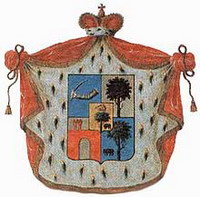
Coat of arms Princes Khilkov's
| 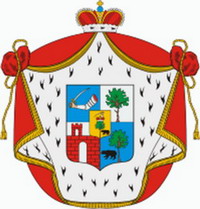
Coat of arms Princes Gagarin's
| What we know about Starodubsky Princedom? It appears, them was two the most ancient existed in territory of the Great Princedom Lithuanian (GPL).
Starodub (in the historical literature or Starodub Seversky) is city in Bryansk area of Russia, an administrative centre of area Starodubskogo. It is located on the river Babinets, in 145 km to a southwest from Bryansk. Starodub is mentioned in Russian written sources, since XI century (1095, siege Starodub). During time Baty’s of invasion has been destroyed by Slavic-Mongols. From the middle of XIV century it is the center of GPL. Has strongly suffered in 1379 from Dmitry Donskogo's armies. In the beginning of XVI century has passed under jurisdiction of the Great Princedom Moscow (GPM). During Vague time Starodub has been burnt, almost all his population was lost. The city has revived and only in 1686 is finally authorized beyond Russia.
Later has arisen Starodubsky Princedom, which capital the city of Starodub (Starodub Volocky, Starodub Ryapolovsky) on the right to coast of the river of Klyazma that in 60 versts from Vladimir was. For the first time Starodubsky Princedom was allocated from structure of the Vladimir–Suzdal ground about 1217-1218, having got in management to Vladimir, son of Vsevolod the Big Jack. However, after ten years, in 1228 Vladimir has died childless, and the territory of his destiny again was part of the Vladimir great Princedom. The independent status of a Princedom has appeared only in 1238. During Vague time the city has been completely burnt by Polish adventurer Lisovsky who in March, 1609 has ruined neighboring territories. In XVIII - the beginning of XIX centuries the city of Starodub has been revived as village Kljazmensky Small town Kovrovskogo of district of the Vladimir province.
Whether so casually Lisovsky has reduced to ashes Starodub on Klyazma and whether the city there in general was? We believe that it was purposeful action to provide "correct" history Starodubsky Princes of Lithuania.
Hence, Starodubsky Princes referred to Polish-Lithuanian Princes, going the sort from Grand Prince Olgerda. Therefore modern Starodubsky Princes any attitude to Vsevolod the Big Jack cannot have.
| 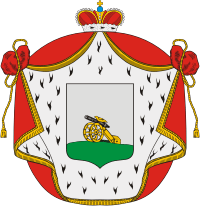
Coat of arms Princes Rzhevsky's
| 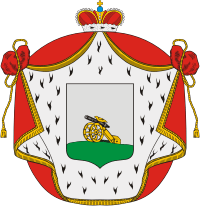
Coat of arms Princes Kropotkin's
| Now we shall consider Princes Rzhevsky. They conduct the sort ostensibly from Smolensk Princes. Prince Fyodor Fyodorovich was specific Prince of city of Rzhevsky and in 1315 has been sent by the Moscow Prince Jury Danilovichem to Novgorod for his protection against the Tver Michael Jaroslavicha's Grand Prince. Novgorodian has given out Prince Fyodor to Grand Prince Tver which has deprived with his destiny. Descendants of Prince Fyodor any more were not called Princes. However at itself, in 400 years, again arise Princes Rzhevsky:
- Jury (George) Alexeevich Rzhevsky (1674-17.04.1729) – stolnik, more than 10 years the governor of the Nizhniy Novgorod province;
- Rzhevsky, Stepan Matveevich (1732-1782) – the general–lieutenant, the hero of Russian-Turkish war 1768-1774;
- Rzhevsky, Ivan Matveevich (after 1734-1793) – the general–major, the hero of Russian-Turkish war 1768-1774;
- Rzhevsky, Paul Matveevich (1734-1793) – the general–lieutenant, the ober-commandant of Moscow.
The arms Rzhevsky is very aggressive: in a board having a silver field, the black gun on a gold gun carriage and on a gun a paradise bird is represented. The board is covered with a cloak and a cap, accessories of Princely advantage. The Princely cap and cloak is appropriated from old to nobiliary sort Rzhevsky because it occurs from Princes Smolensk.
Thus except for Princes Rzhevsky, the similar arms use Princes Kropotkin’s, Vyazemsky’s and in part Shahovskoy’s.
Princes Kropotkin’s rank itself as a branch of specific Princes Smolensk. The ancestor of them was ostensibly Prince Dmitry Vasiljevich Smolensky nicknamed Kropotka, the nephew of last Prince of Smolensk Jury Svjatoslavicha. His descendants in XVI - XVII centuries served stolnik’s, stryapchy’s and were on voevodstvo’s. They then did not use surname Kropotkin. Prince Dmitry Nikolaevich Kropotkin (1836-1879), the Kharkov governor who has been killed on political grounds is known. He had cousins – Petr and Alexander. The sort of Princes Kropotkin’s has been brought in V a part of the genealogical book of the Moscow and Kaluga provinces (Gerbovnik, V, 2). There were also still branches of Princes Kropotkin’s which communication with previous comes is not found out. She occurs from Prince Boris Mihajlovich Kropotkin owning estates in 1627-1629 in the Ryazan province. Therefore actually Kropotkin’s have received a title of Prince not earlier than XVIII centuries.
| 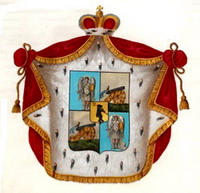
Coat of arms Princes Shahovskoy's
| 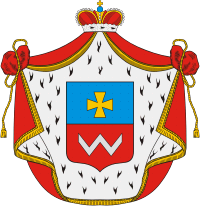
Coat of arms Princes Putyayin's
| Princes Shahovskoy’s it is the Russian Princely sort occuring from Rurik in XVII knee. The ancestor his Constantine Glebovich, Prince Yaroslavl, by a nickname the Check, former colonel in Nizhni Novgorod (1482). Many from Shahovskoy’s referred to still Shemyakin’s, named Prince Alexander Andreevich Shemjaki, but since XVII century all without exception began to refer to Shahovskoy’s. There were many branches Shahovskoy’s, main from them have died away during Distemper, but is the strongest their talents have revealed only at Peter the Great:
- Alexey Ivanovich (1688 - 1752), the councillor of state, the adviser of Ustic-board (the Second branch);
- Alexey Ivanovich (around1690 - 1737, the senator, the general–anshef and governor Malorossia;
- Michael Ivanovich, the privy councillor the senator, since 1753 the president of Chamber–board;
- Grigory Ivanovich, the Belgorod governor, the ambassador in Constantinople in 1758;
- Nikolay Leontjevich (1757 – 1836), the senator, the general – major (the Sixth branch).
The coat of arms of Princes Shahovskoy’s contains the arms of Smolensk. The board is divided into four parts. In the first and third part is the arms of great reigning Kiev: in a blue field the angel in silver fiber to clothes holds in the right hand a naked silver sword, and in left is gold board. In the second and fourth parts the arms of reigning Smolensk is placed: in a silver field, on the green grass, the black gun inverted to the left on a gold gun carriage, and on a gun - a paradise bird. In the middle the arms small shield with the arms of reigning Yaroslavl: in a gold field the black bear to the left inverted, costs on hinder legs and holds on a shoulder a gold poleaxe. The coat of arms is located on an ermine field of the developed Princely cloak and topped Russian Prince Crown.
The most probable descendants of present Princes Shahovskoy’s it is seignioral and nobiliary sort Shehovtsov’s (Haplotypes 33-34). For example, one of Shehovtsov’s served as a stoker at Romanovs at the end of XVII century. Then has gone in soldiers, became the officer, then the general in army Peter the Great. Other representative of a sort from Kursk noblemen Shehovtsov Michael Petrovich (1786-1869) became the general, the hero of domestic war of 1812. Since 1823 on January 20, 1829 – the commander of 3-rd Smolensk Ulan Emperor Alexander III shelf. During Russian–Turkish war « On November 18, 1828 is appointed to consist on a cavalry » with assignment of a rank of the general. Haplotype of Shehovtsov’s we carry to Central Russian Rurikovich.
Putyatin’s it is Russian Princely sort, ostensibly Rurikovich, branch of Princes Drutcky. The ancestor of them, Prince Ivan Semenovich Drutsky (Drutcky) nicknamed Putyata (XVII knee from Rurik), in 1422 has signed the treatise of Lithuania with knight sword. It was supporter Svidrigajla, and in 1436 has moved from Lithuania to Moscow, has acted on service to grand Prince Vasily to II Vasilyevich Dark. But his children (4 sons) have remained in Lithuania GPL (the Great Princedom Lithuanian). Ivan Ivanovich Putjatich had son Bogdan Putyatich and Nikita Putyatich, moved after 1505 to Moskovia with six sons. Prince Pyotr Nikitich Putyatich (Putyatin) and the nephew of it, Prince Semyon Ivanovich (son Ivan Nikitich), have surrendered in a captivity to Lithuanians under Orsha (1514). The "younger" branch originates from Prince Davyd Nikitich actually Princes Putyatin’s, reached up to XX century.
Thus Drutsky’s it is a Princely sort of a disputable origin. In 1508 Drutsky Prince Vasily Dmitrievich together with brothers Bogdan both Andrey and the nephew Prince Dmitry Jurjevich as involved in plot of Prince Glinsky, have been compelled to run from Lithuania to Moscow and to act on service to grand Prince Vasily III Ioanovich. Drutsky’s became ancestors of Princely sorts Drutcky-Sokolinsky, the Konopley–Sokolinsky, Drutcky–Ozersky, Drutcky–Prihabsky, Babichev’s, Drutcky–Lubetsky, Drutcky–Gorsky, Putyatin’s and of some others. They used coat of arms Drutsk (Polish is Druck).
The Polish scientists assert that authentically known Prince Drutsky Dmitry was the son of Grand Prince Lithuanian Olgerd (Dmitry Olgerdovich). This version has been maintained by authoritative Polish historian S.M.Kuchinskim in his monography and encyclopaedic clauses [5].
Thus, Princes Putyatin’s are a part Polish-Lithuanian Szlachta both descendants Olgerd and any image Rurikovich cannot be. The family tree « from Rurik » has been forged Romanov’s Genealogist’s in XIX century.
| 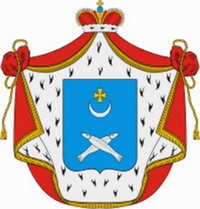
Coat of arms Princes Vadbolsky's
| 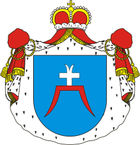
Coat of arms Princes Puzyna's
| Irrespective of the mentioned Princes cost Vadbolsky’s and Puzyna.
Vadbolsky’s it is Russian Princely sort. Jakoby Rjurikovichi, branch of Princes of Belozerskys. The ancestor of a sort – Ivan Andreevich, Prince Vadbolsky (XVIII knee from Rurik), the son of Prince Andrey Jurjevich owning the grounds on the river Andoge and Vadbolsky by Princedom, the grandson of last sovereign Prince Belozersk Jurij Vasiljevich. Ivan Andreevich lived in XV century and has received volost Vadbola from the father, whence has received the family prorank.
Princes Vadbolsky’s have again come in a Princely dignity only at itself. Here their oustanding representatives:
- Theodosius (Vadbolsky) (1663-1712) – bishop Krutitsky;
- Vadbolsky, Ivan Mihajlovich (1781-1861) – the participant of Napoleonic wars;
- Vadbolsky, Peter Alekseevich (1831-1885) – the philanthropist.
In our opinion Vadbolsky’s Princes it is the branch of the Lithuanian Princes going from the Pskov Prince Dovmont.
Puzyna is Russian Princely sort. Occurs ostensibly from sacred Prince Michael Vsevolod Chernigovsky (has died in 1246), which great-great-grandson Prince Tit–Jury Fyodorovich Kozelsky (from Rurik XV knee) had two sons: Prince Grigory Titovich (Juryevich), by a nickname Ogon’, becoming ancestor Oginsky’s, and Prince Vladimir Titovich (Juryevich), by a nickname Bubble, ostensibly becoming ancestor Puzyn. Historian S.L. Ptashitsky, on the basis of documents, conducts sort Puzyna’s from the second son of Prince Ivan Vasiljevicha Glazyni of Prince Ivan Ivanovicha Puzyna who has received from king Sigismund court yard Nosovo in Melnik’s povet, and about the brother of the last – Prince Dmitry Ivanovich, speaks, that from him there was a sort of Princes Oginsky. In any case, ancestors Puzyna entered unequivocally in Polish-Lithuanian szlyahta and have appeared in Russia only after the unit of Reech Pospolita in XVII - XVIII centuries.
| 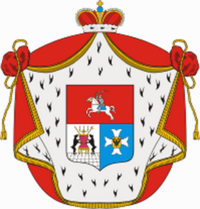
Coat of arms Princes Golitsyn's
| 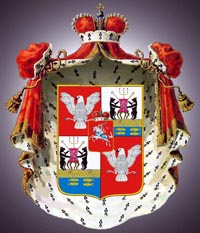
Coat of arms Princes Khovansky's
| It is even more to fog with genealogy of Princes Myshetsky’s. Myshetsky occur under the family legend from Markgraf Meisen’s Andrey who has left as if from Saxony to Russia in 1209. However historian G.A. Vlasjev in the book, leaning on the existing or invented documentary certificates, wrote about an origin of Princes Myshetsky’s the following [6]:
« In annals about Princes Myshetsky’s it is told: « And Prince Michael (Vsevolodoch) the son Prince Jury has remained and has left the fatherland empty, and has come in Tarusa, and in Tarusa rules and has made 5 sons. The senior son called Orehva, and the nickname to it was Vsevolod, and another was Semen, and the third Michael, and the fourth Ivan, and the fifth Constantine. Also has divided him after the stomach fatherland: to grown-up Vsevolod – Tarusa, Semen – Kanin, to Michael – Myshaga and to Ivan – Volokna and to Constantine – Obolensk ».
Further, « Accepting, thus, Princes Myshetsky’s for posterity of Prince Michael Jurjevich, the grandson sacred Michael Vsevolodovich Chernigovsky, we, unfortunately, have no several intermediate generations, between Michael Jurievichem and known to us on a list to ancestors, Prince Andrey (in christening Fedor) »
The sort of Princes Myshetsky’s till second half XVII century entered in ten the richest land owners of Russia. Then it has grown poor because majority Myshetsky’s after church split remained adherents of old belief and exposed to persecutions and arrests, and their grounds have been confiscated. In any case, Myshetsky’s when they still had big money, steel Princes at Romanov’s.
Let's consider now sorts of the Lithuanian Princes which have located in Russian Empire and for rank Rurikovich’s never applied.
Golytsin’s it is an ancient Russian Princely sort, Gediminovich’s, a branch of Princes Patrikeev’s, branch Narimunt, son Gedimin. Golytsin’s, perhaps, the most numerous Princely sort of Russia, since XVIII century divided on four large branches. Golytsin’s entered into number 16 of sorts which representatives in XVII century erected in a seignioral grade directly from stolnik, passing a grade okolnichy. To doubt of talents of sort Golytsin’s and his merits it is not meaningful. Vasily Vasiljevich Golitsyn participated in events of 1610-1613, was one of applicants for the Russian throne; later – Princes, senators, scientific, military. However it is possible to assert, that Golytsin’s was much and all descendants did not have not enough Princely titles and worthy posts at the Russian crown. The greatest blossoming of family has fallen XVIII-XIX to centuries.
Khovansky’s it is Russian Princely sort which occurs from grand Prince Lithuanian Gedimin and Narimunt, a branch of Princes Patrikeev’s, as well as Golytsin’s. Grandson Patrikeya – Vasily Fyodorovich nicknamed Havaka – also was the ancestor of a Princely sort of Khovansky’s playing in XVII century an outstanding role at Romanov’s among 16 exclusive surnames which members in reign of Tsar Alexey Mihajlovicha were directly erected in boyars. For the first time Princes Khovansky’s are mentioned in first half XVII centuries, for example, Prince Andrey Andreevich (has died in 1629) – colonel. In 1615-20 was colonel in Astrakhan, in 1626-28 – in Tobolsk. In 1629 has been sent on colonel to Nizhni Novgorod where soon and has died. The greatest blossoming of family of Khovansky’s has taken place in XVIII-XIX centuries. Despite lacking a trustworthy information, it is possible to believe confidently, that sorts Golytsin’s and Khovansky’s have gone away in the beginning of XVI century, i.e. 500 years ago. It is interesting, that the genetic distance between Princes Golitsyn and Khovansky makes 7 single-step mutations for 500 years.
| 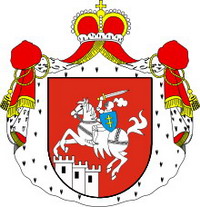
Coat of arms Princes Chartoryysky's
| 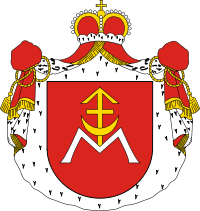
Coat of arms Princes Mosalsky's
| Chartoryisky’s or Chartoryizsky, Chartoryzsky it is a Princely sort in the Great Princedom Lithuanian, and then in the Lithvanian-Polish state of the arms of the Pursuit Lithuanian, Gediminovich’s. Have received surname from the name of patrimonial possession Old Chartoryisk (above the river Styr) on Volhynia. Is borrowed the maximum state and administrative posts. Chartoryisky’s conduct the sort from Constantine is the grandson of grand Prince Lithuanian Gedimin. Theoretically sorts of Princes Chartoryisky’s, Golytsin’s and Khovansky’s have gone away on a boundary of 1400. Thus is genetic distance Chartoryisky with Golitsyn 4, and with Khovansky of 5 single-step mutations. These figures cause the big doubt in their reliability.
Sort Svistunov’s, we believe, concerns to branches of Princes Golitsyn or Khovansky’s separated in XVII-XVIII centuries. Genetic distance Svistunov with Princes Chartoryisky – 4, Golitsyn – 4 and Khovansky – 5 single-step mutations.
Hence, Polish-Lithuanian Gediminovich’s on the basis of genetic given and annalistic materials have gone away on different branches in the middle of 1400th years. Calculated by us modal Haplotype "Gedimin" D corresponds to great-grandsons of legendary Grand Prince. It is correct to name it Haplotype Patrikeev’s, instead of Gedimin. Gediminovich’s documentary never insisted on the accessory to Rurikovich. However in our opinion, Gediminovich’s are cousins Rurikovich and belong to the Sort of Russia. When branch Gediminovich’s has departed the Sort of Russia – up to Rurik or after him – will be shortly determined, when will be typed more than a statistical material on Haplotype.
Let's return now to name Rurikovich from Polish-Lithuanian Szlachta, received titles of Princes at Romano’s in XVII-XIX centuries.
Typical representatives "Rurikovich’s" from Lithuania is Prince Mosalskie. One of them has handed over 37-markers the analysis. Lives Massalsky in Poland. Here it Haplotype. 38. Haplotype Prince Mosalsky:
14 23 14 11 11 13 11 12 10 14 14 30 18 9 9 11 12 25 14 19 28 14 14 15 15
11 11 18 20 14 15 15 19 34 34 15 10
Distance in single-step mutations from Haplotype C – 2 (on 37 markers).
Distance in single-step mutations from Haplotype A – 6 (on 37 markers). Thus, genetic distance Mosalsky makes on 37 markers of 2-3 single-step mutations from other Lithuanians, ostensibly Rurikovich’s.
Mosalsky’s it is Russian Princely sort, branch of Princes Chernigov. The ancestor Prince Jury Svjatoslavovich Karachevsky (probably XV knee from Rurik), living in second half XV centuries, has received from the father in destiny the city of Mosalsk and became the first specific Prince Mosalsky. This destiny entered in GPL.
From Jury Svjatoslavicha's three sons of Princes Vladimir, Vasily and Seeds Jurievich have gone three branches of a sort. At the end of XVI century Princes Mosalsky steel vassal’s the Great Princedom Lithuanian. Prince Afanasiy-Vladislav in the beginning of XVIII century has been taken from descendants of Prince Vladimir Jurjevicha in captivity and has remained in Russia with posterity. Great-grandsons of Prince Vasily Jurjevicha Princes Vasily Koltso, Andrey, Roman and Petr Semyonovich have returned to Russian citizenship, and Prince Vasily Semyonovich Koltso became the ancestor of separate branch Koltsov–Mosalsky’s. Other branches of Princes Mosalsky’s have remained to serve Lithuania.
Leaves, that sort Mosalsky’s was formed about 1500. Thus it belong Polish-Lithuanian Szlyahta, and names itself Rurikovich. Haplotype Mosalsky’s are identical Haplotype various "Rurikovich’s" from numerous branches of a sort of Russian Princes which have gone away 900 years ago. The official genealogy of Russian Nobiliary Assembly headed by Stanislav Vladimirovich Dumin, asserts, that all these people Rurikovich and Monomakhich.
Here just also elements of forgery of the family trees made employed Romanov’s Genealogist’s in XIX century when the forged Russian history was formed are shown.
Let's asked question – Why genes of Princes from Polish-Lithuanian Szlachta at all were not exposed to mutations for 900 years of existence Monomakhich’s? Why genetic distances of these "Rurikovich’s" make among themselves 3-4, sometimes 7-8 single-step mutations?
At the same time at Gediminovich’s the same results are traced for 500 years. For example, the genetic distance in 7 mutations at Golitsyn and Khovansky was formed for 400-500 years. The genetic distance in 4 mutations at Shehovtsov’s and Kartsev’s has developed for 300-350 years.
Let's put forward a hypothesis Pseudo - Rurikovich’s on which "Rurikovich" from Polish-Lithuanian Szlachta and RNA at all Rurikovich though belong to the Sort of Russia, ethnic Finno-Ugric, Haplogroup N1c1, and it is simple cousins Rurik.
Starodubsky’s Princes GPL, Myshetsky’s, Mosalsky’s and Putyatin’s on the origin precisely specify the Great Princedom Lithuanian. It is proved, that Putyatin’s in general it is branch of Prince Olgerd. If genes of Putyatin coincide with the others, so also Lithuanian "Rurikovich" in fact is descendants of Olgerd.
The traditional history names Olgerd (1296-1377) son Gedimin (1275-1341) and brother Kejstuta (1297-1382). Thus in Russian annals of these brothers name son of Doment or Ediment. Doment it is necessary the son there is nobody Scolomed.
According to Andrey Olgerdovich, resulted in Zadonchina [7]:
« Told Andrei Olgordovich to the brother: « Brother Dmitrey, it is we two brother, we sons Olgrodov’s, and grandsons we Doment, and great-grandsons is Scolomed »
In Cyril–Belozersky the list [8]:
« Told Andrei to brother Dmitrey: « It self is two brothers, children Volyard, grandsons Ediment, great-grandsons is Scoldomer... »
However Gedimin it is considered son of Pukuver Budivid. At Gedimin senior brother Viten (has died in 1316) was. We shall put forward a hypothesis on which we deal with two sorts of the Lithuanian Princes – Grand Prince Gedimin and the Pskov Prince Dovmont. Gedimin was son Pukuvera Budivida (has died in 1294/1295) or Viten, and Olgerd was son Doment-Ediment-Dovmont (has died in 1299) and great-grandson Skoldimer-Skolomend.
Attribution name Gedimin with name Doment-Ediment-Dovmont it is erroneous, in fact in other Russian annals word Gedimin and is written, without distortions. We believe correct an identification of Grand Prince Lithuanian Dovmont with the Pskov Prince Dovmontom, despite of different dates of their death 1285 and 1299 accordingly.
Dovmont, Prince of Pskov of the Lithuanian origin, has become famous for participation in plot against the first Grand Prince Lithuanian Mindovg (1195-1263). In 1263 it and two his juvenile sons have been killed as a result of intrigues of Princes Gemanty Troynat, Polotsk Tovtivil and Pskov Dovmont [9]. In 1264 Grand Prince became senior son Mindovga Vojshelk, but in 1267 it has refused authority and has left in orthodox (the Greek ceremony) a monastery in Ugrovesk. Therefore lineal descendants Mindovg did not remain.
This hypothesis explains genetic discrepancy of modern descendants Olgerd Dovmontovich (1296-1377) and Narimunt Gediminovich (1294-1348).
Thus Princes groups Polish-Lithuanian Szlachta have very similar genes proving their origin in Southern Baltic 500-700 years ago. Directly ahead of a spelling of given clause it was found out, that all "Rurikovich" have same SNP L550 +. This parameter divides Finno-Ugric on two groups: east Ugric – Finno-Russian branch (L550–) and western Ugric – the Southern–Baltic branch (L550 +). For a substantiation of Swedish origin Rurik Genealogist have thought up the Scandinavian branch Ugric, however she is small and fully complies with the Southern–Baltic branch. We believe that such division is a tribute to the political order in a science, producing RNA.
Abundantly clearly, that coat of arms Putyatin’s, Puzyna’s and Mosalsky’s obviously give out the South-Baltic, Lithuanian origin of Princes which to Rurikovich have no attitude.
| 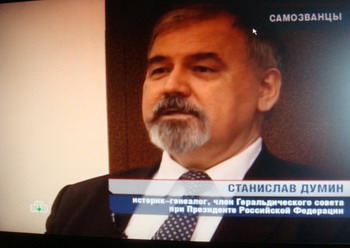
The Lithuanian phenotype of szlyahtich S.V. Dumin
| 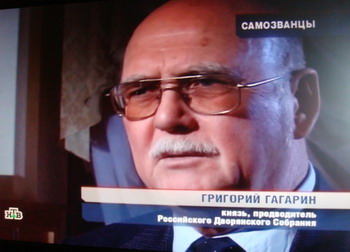
The Lithuanian phenotype of Prince G.G. Gagarin
| Hence, we notice forgery in the genealogy, connected with attribution descendants Olgerd Dovmontovich with Rurikovich. Within the framework of traditional DNA-Genealogy Polish-Lithuanian Rurikovich cannot be descendant Rurik in any way as form an independent branch on a tree of the Sort of Russia. In fact at speed of mutations one marker for 200 years and distances of 7-8 mutations, they should have the general ancestor 1400-1600 years ago, that exceeds 1200 – date of birth Rurik.
On the contrary, on our representations, within the framework of logarithmic model of calculation of a life of the general ancestor under Kubarev’s formula [10], both descendants Olgerd and descendants Narimunt can be Rurikovich which branches have gone away in X a century from sons Svyatoslav, Gleb or Sacred Vladimir. So at speed of mutations one marker for 100 years and distances of 10-12 mutations, they should have the general ancestor 1000-1200 years ago. Simultaneously there should be a ramified tree present Rurikovich’s, genetically close to tsars of the Volga Bulgaria and Genghiskhan’s.
Now we shall be set by questions – Why in territory of the central, southern and northern Russia in general is not present Rurikovich’s? Where is disappeared Princes and khans of Moskovia, the Volga region, the Volga Bulgaria, Golden Horde and Siberia?
The Kiev Russia has existed till 1240 when Kiev has been inverted in ruins by the Slavic-Mongolian armies. Simultaneously with expansion Horde’s on the West there was an expansion of the Polish-Lithuanian Princes on the south and the east. Therefore the territory to the north from Kiev has got under the control GPL. Escaped elite Rurikovich’s has moved from the West on the north and the east of Russia. Piously the place is empty it does not happen, therefore thrones of ancient Russian Princedoms, such as Chernigov, Polotsk, Lubech, Smolensk and others have been borrowed Polish-Lithuanian Szlyahta.
In 1237-1240 Russian Princedoms have undergone to devastation Mongols. In 1243 the Vladimir Prince Jaroslav Vsevolodovich has been caused to Baty and recognized as the oldest Prince in Russia. At the end of 1250th census has been lead and regular operation of Princedoms by Mongols began. After Alexander Nevskogo's death (1263) Vladimir has ceased to be a residence of grand Princes. During XIII century specific Princedoms with own dynasties were formed: Belozersk, Galic-Dmitrov, Gorodeck, Kostroma, Moscow, Pereyaslavl, Rostov, Starodub, Suzdal, Tver, Uglich, Uriev, Yaroslavl (all up to 13 Princedoms), and in XIV century Tver, Moscow and Nizniy Novgorod–Suzdal Princes began to be titled Great. Actually Vladimir great reigning including city Vladimir with extensive territory in a zone Suzdal opolie and the right of gathering of a tribute for the Horde from all Princedoms of Northeast Russia, except for great, one of Princes Rurikovich’s received on a label from Horde khan.
In parallel events of submission of Russian Princedoms to Golden Horde, the religious authority on behalf of metropolitan of All Russia moves in 1299 from Kiev in Vladimir, and in 1327 to Moscow.
Descendant Mstislava of Great, senior son Vladimir Monomaha, Rostislav III Mstislavovich, died in 1232, was penultimate Prince of Smolensk. His son Sacred Feodor Rostislavovich after 1238 gets over to Yaroslavl and becomes the Yaroslavl Prince. It speaks about moving Russian elite Rurikovich’s from the West on the east.
Thus in 1236 the Great Princedom Lithuanian under management Mindovg which in 1244-1246 refers to as Grand Prince Lithuanian-Myndow, hoeste konic, der Littowen kunic rich [11] blossoms. It is called the same title in Russian - Ipatiy, Gustyn and the Novgorod annals. By time of acceptance Mindovg of a Catholicism in 1252 Lithuania already was the taken place state with capital in Novogorodok, including such cities as Cores, Troki, Shavli, Kovno, Grodno, Polotsk, Vitebsk, Drutsk and Pinsk, that is practically all territory of present Belarus, and also the most part of Lithuania. Simultaneously Prince in Polotsk cousin Mindovg is Tovtivil sat. In 1254 the world with Galich Russia on which Novogorodok it was transferred the son of the Galich-Volynsk Prince Daniel – to Roman has been made. However in 1263 Mindovg has been killed by conspirators [9]. Names of Princes - murderers Tovtivil, Dovmont and Troynat speak that Rurikovich’s in elite of the new state practically did not remain. The Smolensk Princedom, since 1250th, in a result has got in dependence on the Great Princedom Lithuanian.
Thus the control over the Russian grounds entering into the Great Princedom Lithuanian, Rech Pospolitaya and in part the Polish Kingdom remained with Golden Horde and Crimean Khanate. In XIV-XVI centuries Bulgarian khans, quite often being proteges of the Lithuanian Princes and resorting to their protection and protection in struggle against the internal political opponents and neighbours, continued to receive a tribute from the Russian grounds which have got under authority GPL and to give out Lithuanian Princes on management of them labels from which it is known about the following [12]: - Lebel Abdulla (Mamay) to Olgerd (1362);
- Label Tohtamysh to Yagailo (1392-1393);
- Label Tohtamysh to Vitovt (1397-1398);
- Label Hadji-Girey to Vitovt;
- Label Ulug-Mohammed to Svidrigajlo (1431);
- Label Hadji-Girey to Sigismund Keystutievich;
- Label Hadji-Girey to Casimir (1461);
- Label Nur-Devlet to Casimir (1466);
- Label Mengli-Girey to Casimir (1472);
- Label Mengli-Girey to Sigismund I (1507);
- Labels Mengli-Girey to Sigismund I (1514);
- Label Mohammed-Girey to Sigismund I (1520);
- Label Sagip-Girey to Sigismund I (1535);
- Label Sagip-Girey to Sigismund I (1540);
- Label Devlet-Girey to Sigismund II (1560).
In 1320th under authority of Grand Princes Lithuanian pass already South Russian the lands with Kiev though some historians deny historical reliability of data on submission of Kiev Gedimin. In the south of possession Olgerd have extended connection Bryansk, Severskoy and the Chernigov Princedoms (about 1360). Smolensk sometimes got under the control of Moscow, but belonged to Lithuanians or Poles is more often. Within Ivan Terrible's board the border of Rech Pospolitaya passed near Mozhaisk in the West and Tula in the south. We can consider a card of Rech Pospolitaya and the Great Princedom Lithuanian which eloquently speak about loss Rurikovich’s of all ancient Princedoms in the West of Russia, including Kiev and Smolensk. The Chernigov Princedom has completely come in Lithuania since 1401.
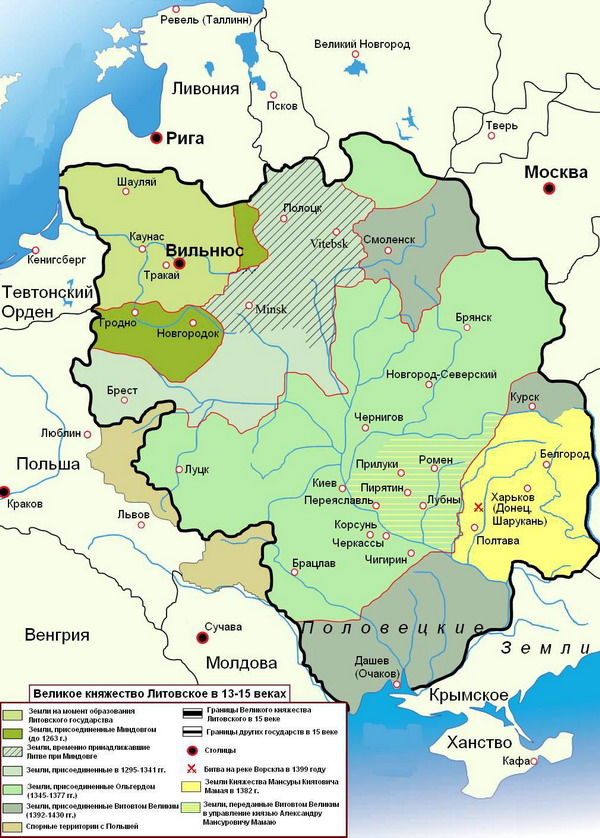
Great Princedom Lithuanian in XIII-XV centuries.
To assume, that the Catholic elite of Lithuania and Poland gave reigning to descendants Russian Rurikovich’s in these grounds - absurd. At them quite sufficed Polish-Lithuanian Szlachta from the Sort of Russia – descendants of children Gedimin and Dovmont. The confederation of Poland and Lithuania has existed from July 1 till October 24, 1795. Only during huge demographic and ground losses during a so-called Swedish flood, the Russian-Polish war of 1654-1657 and Great northern war, the part of the Polish elite from the Sort of Russia began to get over to Russia. It has led to to occurrence within Reign Peter the Great numerous Princes "Rurikovich’s" from Lithuania – former Smolensk, Chernigov and other Princedoms.
Finally Polish-Lithuanian state has been divided in 1772-1795 between Russia, Prussia and Austria. By this time the most part has located in Russian Empire Szlachta which part has hastened to enter the name in "Rurikovich", buying at dexterous historians and Genealogists family trees from « present legendary Rurikovich’s ».
It is logical to assume, that all newly appeared self-appointed Rurikovich should belong to narrow group patrimonial elite Lithuania as Poles in the basic weight Slavs, and in Lithuania lived Baltic Finno-Ugric including representatives of the Sort of Russia. These assumptions authentically illustrate results of genetic researches of Princes of Russian Empire. The first cluster Princes make Gediminovich’s is Golytsin’s, Khovansky’s and others which it is formal and so is considered Lithuanian Princes. The second cluster Princes is "Rurikovich", having extremely big genetic affinity in 3-4, in the worst case of 7-8 single-step mutations on 67 markers Haplotype. It means existence of the general ancestor Lithuanian "Rurikovich’s" the first cluster 500-600 years ago and the second cluster 600-700 years ago.
Let's define now true the third cluster Russian Princes Rurikovich’s who lived and corrected in huge territory of Russia and Golden Horde – from Kiev and up to Altai. This group of people should possess the genes corresponding to borrowed territory. In our representation clusters Rurikovich’s can be divided on sign SNP L550 either plus or minus. The minus corresponds to Finno-Russian group. In fact Rurik and his descendants corrected in the north and in the center of Russia and the Volga region, instead of in Baltic. Thus there will be the transitive group possessing qualities both Southern – Baltic, and the Finno-Russian clusters.
In Russian history hundreds Princedoms in which corrected Rurikovich–Horde’s are known. Horde’s we shall name representatives of the Sort of Russia who have remained in northern, east and southern Russia, and also in Golden Horde to the Volga region. These Rurikovich with the elites and peoples have come in the Mongolian Empire, approximately since 1240th.
Let's make the list of Russian Princedoms alphabetically where we shall specify the name, time of existence, an arrangement, capital and an accessory to Great Princedoms Moscow (GPM) or Lithuanian (GPL): 1. Andojsky a Princedom (around 1385-1430). The capital is unknown;
2. Baryatinsky a Princedom (around 1450-1504/9). Capital Baryatin (nowadays Baryatino in the Kaluga area);
3. Belgorod Princedom (around 1149-1205). Capital Belgorod - Ryazan;
4. Belgorod Princedom. Capital Belgorod (nowadays village Belogorodka in the Kiev area of Ukraine);
5. Belyvsky a Princedom (1468-1558). Capital Belyov. 1487 → GPM (destiny up to 1558);
6. Belozersky a Princedom (1238-1486). Capital Beloozero (nowadays Belozersk), with 1432 Vereya;
7. Beloselsky a Princedom (around 1385-1470). Capital White Village;
8. Belzsky a Princedom (1170-1269). Red Russia (Galicia). Capital Belz;
9. Boguslavlsky a Princedom. Capital Boguslavl;
10. The ground Bolohovskaya (Bolhovsky’s Princedoms) (?-? 1240). Capital Kamenets;
11. Borisovsky a Princedom (around 1101-1245). Capital Borisov;
12. Bohtuzny a Princedom (1364-1434);
13. Brest Princedom (around 1087-1444). The ground Berestesky (podlyashie, initially area of the Kiev Princedom). Capital Brest (Berestie);
14. Bryansk Princedom (around 1240-1430). Capital Bryansk (Debryansk);
15. Vadbolsky a Princedom (around 1410-50). The capital is unknown;
16. Vasilievsky a Princedom. Capital Vasiliev;
17. Vereisky a Princedom (1432-86);
18. Verhovsky’s Princedoms – the east of the Chernigov ground;
19. Vitebsk Princedom (1101-1320/1392). Capital Vidbesk;
20. Vladimir-Volynsk Princedom (around 990-1452). Capital Vladimir-Volynsk;
21. Vladimir-Suzdal Princedom (1125-1362). Capitals Rostovs, Suzdal, with 1157 Vladimir on Klyazma. About 1169 great Princedom;
22. Volkovyisky a Princedom (around 1245-1260-Ñ). Capital Volkovyisk;
23. Volkonsky a Princedom (around 1270-1470). Capital Volkona (Volhona, Volkonsk);
24. Vologda Princedom (1433-81). Capital Vologda;
25. Voloksky a Princedom (1408-10 (1462-1513). Capital Volok Lamsky (nowadays Volokolamsk);
26. Vorgolsky a Princedom (after 1202-?). Capital Vorgol;
27. Vorotynsky a Princedom (around 1455-1573). Capital Vorotynsk. 1493 → GPM (on the rights of destiny till 1573);
28. Vshchizhsky a Princedom (1156-1240). Capital Vshchizh;
29. Vyshgorodsky Princedom (1077-1210). Capital Vyshgorod;
30. Vyshgorodsky a Princedom. Capital Vyshgorod;
31. Vyazemsky a Princedom (1190-1403/1494). Capital Vyazma. → GPL;
32. Galichsky-Volynsky Princedom;
33. Galichsky a Princedom (1084-1352). Capital Galich Southern, about 1290 Lvov;
34. Galich-Mersky a Princedom (1246-1453). Capital Galich Mersky;
35. Gluhovskoy a Princedom (around 1246-1407). Capital Gluhov;
36. Golibesovsky a Princedom (around 1410-1510). Capital village Troitskoe;
37. Gomel Princedom (?-?). Capital Gomy (Gomel);
38. Gorodensky a Princedom (1425-35);
39. Gorodensky (Grodno) Princedom (1127-1260-Ñ/1365). Capital Gorodno (Grodno, Goroden’);
40. Gorodetsky a Princedom (1264-1403). Capital Gorodets;
41. Gorodets-Ostersky a Princedom. Capital Gorodets-Ostyorsky (Oster);
42. Dmitrovsky a Princedom (1238-1569). Capital Dmitrov;
43. Dorogobuzhsky a Princedom (Tver) (1318-1486). Capital Dorogobuzh;
44. Dorogobuzhsky a Princedom (Volhynia) (around 1085-1227). Capital Dorogobuzh;
45. Dorogobuzhsky a Princedom (Smolensk) (around 1343-1505). Capital Dorogobuzh. 1403 → GPL;
46. Drutsky a Princedom (around 1150-1326/1508). Capital Drutesk (Drutsk);
47. Drutsky-Podberezovsky a Princedom (around 1320-1460). The capital is unknown;
48. Dubrovetsky a Princedom (? (not later than 1236)-?). Capital Dubrovitsa;
49. Yeletsky a Princedom (around 1370-1483). Capital Yelets (Karasy);
50. Ersitsky a Princedom (?-?). Capital Ersika (Gertsike);
51. Zaozersky a Princedom (around 1400-1447/52). The capital is unknown;
52. Zvenigorodsky a Princedom (1331-1492). Capital Zvenigorod;
53. Zvenigorodsky a Princedom (around 1340-1504). Capital Zvenigorod-na-Oke;
54. Zubtsovsky a Princedom (1318-1460);
55. Izjaslavsky a Princedom (?-?). Capital Izjaslavl (Volynsk);
56. Izjaslavsky a Princedom (around 1101-1245). Capital Izjaslavl (Minsk);
57. Kaluga Princedom (1505-18). Capital Kaluga;
58. Karachyovsky a Princedom (around 1246-1360). Capital Karachyov;
59. Kargolomsky a Princedom (around 1375-1430). The capital is unknown;
60. Kashinsky a Princedom (1318-1426). Capital Kashin;
61. Kemsky a Princedom (around 1375-1430). Capital village Kem;
62. Kiev Princedom (1132-1471). Capital Kiev;
63. Kletsky a Princedom (around 1250-1521). Capital Kletsk (Klechesk);
64. Kobrinsky a Princedom (1366-1529). Capital Kobrin. The Lithuanian destiny in 1366-1490, the Polish destiny in 1490-1529;
65. Kozelsky a Princedom (around 1235-1445). Capital Kozelsk;
66. Koknessky a Princedom (?-?). Capital Koknese (Kukenoies);
67. Kolomna Princedom (around 1165-1301). Capital Kolomna;
68. Koninsky a Princedom (?-?). Capital Konin (Kanin’);
69. Korsunsky a Princedom. Capital Korsun;
70. Kostroma Princedom (1246-1303). Capital Kostroma;
71. Kotelniksky a Princedom;
72. Krasinsky a Princedom. Capital Krasn;
73. Kremenetsky a Princedom (?-?). Capital Kremenets;
74. Krivoborsky a Princedom (around 1440-70). The capital is unknown;
75. Kubensky a Princedom (?-1447), Capital Kubena;
76. Kurbsky a Princedom (around 1425-55). Capital village Kurba;
77. Kursky Princedom (around 1095-1270). Capital Kursk (Kuresk);
78. Lipetsky Princedom (around 1283-??). Capital Lipetsk;
79. Logozhsky a Princedom (around 1150-1245). Capital Logozhsk (Logoisk);
80. Lukomlsky a Princedom (1178-XVI a century). Capital Lukoml;
81. Lutsky a Princedom (1099, 1125-1320). Capital Lutsk (Luchesk);
82. Lialovsky a Princedom (around 1440-60);
83. Ljubutsky a Princedom (around 1235-1445). Capital Ljubutsk (Ljubutesk);
84. Mezetsky a Princedom (around 1360-1504). Capital Mezetsk (Mezchesk, nowadays Meshevsk). 1493 → GPM;
85. Mikulinsky a Princedom (1339-1485). Capital Mikulin;
86. Minsk Princedom (around 1101-1326/1407). Capital Mensk (Minsk);
87. Mozhaisky a Princedom (1279-1303). Capital Mozhaisk. → GPM (specific Princedom 1389-1492);
88. Mozhaisky a Princedom (1389-1492);
89. Mologsky a Princedom (around 1325-1450). Capital Mologa;
90. Mosalsky a Princedom (around 1350-1494). Capital Mosalsk (Masalsk). 1500 → GPM;
91. Moscow Great Princedom (1276-1547). Capital Moscow;
92. Mstislavsky a Princedom (around 1370-1529). Capital Mstislavl;
93. Murom Princedom (989-1393). Capital Murom. → GPM;
94. Mtsensky a Princedom (?-?). Capital Mtsensk. 1500 → GPM;
95. Myshegodsky a Princedom (around 1270-1488). Capital Myshegda (Myshaha);
96. Nizhniy Novgorod Princedom;
97. Novgorod–Seversky a Princedom (around 1096-1494). Capital Novgorod – Seversky;
98. Novgorod ground (X century – 1478). Capital Novgorod (Mister Great Novgorod);
99. Novlensky a Princedom (around 1400-70). Capital village Novleno;
100. Novgrudsky a Princedom (around 1245-1260-Ñ/1431). Capital Novgorodok; (Novgrudok). Primary possession Mindovg around of which it began to collect GPL;
101. Novosilsky a Princedom (sulfurs. 13 century - 1425). Capital Novosil. → GPM (not later than 1494);
102. Obolensky a Princedom (around 1270-1494). Capital Obolensk (Obolenensk). → GPM 1362-89;
103. Ovruchsky a Princedom. Capital Vruchy (Ovruch);
104. Odoevsky a Princedom (1376-1407). Capital Odoev. → GPM 1474 (on the rights of destiny till 1547);
105. Palitsky a Princedom (around 1390-1470);
106. Peremyshlsky a Princedom (?-?). Center Peremyshl (Kaluga area) (on Oka). → GPM 1487;
107. Peremyshlsky a Princedom (1085-1269). Capital Peremyshl (Poland) (nowadays Przemysl in Poland);
108. Peresopnitsky a Princedom (1146-1238). Capital Peresopnitsa;
109. Pereyaslavlsky a Princedom (1054-1239). Capital Pereyaslavl Southern (Russian) (nowadays Pereyaslav-Khmelnitskiy);
110. Pereyaslavlsky-Zalessky a Princedom (1175-1302). Capital Pereyaslavl (nowadays Pereslavl – Zalessky);
111. Pinsky a Princedom (around 1168-1521). Capital Pinsk (Pinesk);
112. Pozarsky a Princedom (around 1390-1470);
113. Polotsk a Princedom (around 960-1307/1399). Capital Polotsk (Polotesk). 1307 → GPL;
114. Poniziesky (Vygontsi Galichsky) (? - 1240) – between Dnestr and Carpathian mountains (territory of the future Moldova). Capital (?) Berlad’ (Byrlad). Was part of Golden Horde;
115. Porosisky (Torchesky) a Princedom (?-?). Capital Torchesk;
116. Porhovsky a Princedom (1386-1442). Capital Porhov. 1404 → GPL;
117. Prozorovsky a Princedom (around 1408-60). Capital Prozorov (nowadays village Prozorovo);
118. Pronsky a Princedom (1129-1465). Capital Pronsk. From the middle of XIV century great Princedom;
119. Pskov feudal republic (XI century - 1510). Capital Pskov (Pleskov);
120. Putivlsky a Princedom (around 1150-1500). Capital Putivl;
121. Radonezhsky a Princedom (1410-1425). Capital Radonezh;
122. Repeisky a Princedom (?-?). Capital Ropesk (New Ropsk);
123. Rzhevsky Princedom (1408-10, 1462-1526). Capital Rzhev;
124. Romanovsky a Princedom (?-?);
125. Romodanovsky a Princedom (around 1410-40);
126. Rostovsky a Princedom (around 989-1474). Capital Rostov;
127. Ruzsky a Princedom (1494-1503). Capital Ruza;
128. Rylsky a Princedom (around 1152-1523). Capital Rylsk;
129. Ryazansky Princedom (1129-1510). Capital (Old) Ryazan, about 1237 Pereyaslavl;
130. Ryazan (New Ryazan). From the end of XIII century a great Princedom;
131. Ryapolovsky a Princedom (around 1390-1440);
132. Serpukhovsky a Princedom (1341-1473);
133. Sitsky a Princedom (around 1408-60). The capital is unknown. On the river Sit (inflow Mologa);
134. Slonimsky a Princedom (around 1245-1260-Ñ). Capital Uslonim (Slonim, Vslonim);
135. Slutsky a Princedom (around 1240-1587). Capital Slutsk (Sluchesk);
136. Smolensk Princedom (around 990-1404). Capital Smolensk. → GPL;
137. Snovsky a Princedom (?-?). Capital Snovsk;
138. Spashsky a Princedom (?-?). Capital Spash (Ispash). → GPM (Novosilsky destiny);
139. Staritsky a Princedom (1519-63). Capital Staritsa;
140. Starodubsky a Princedom (1238-1460). Capital Starodub;
141. Starodubsky a Princedom (1095 – the Lithuanian destiny about 1406-1503). Capital Starodub Chernigovsky (Bryansk area);
142. Sugorsky a Princedom (around 1345-75);
143. Sudsky a Princedom (1455-1510) Capital village Sudka;
144. Suzdalsky Princedom;
145. Suzdalsky-Nizhniy Novgorod Great Princedom (1238-1424). Capital Suzdal and with around 1350 is Nizhni Novgorod;
146. Tarussky a Princedom (1246-1392). Capital Tarusa. → GPM 1392;
147. Tversky Great Princedom (1242-1490). Capital Tver;
148. Telyatevsky destiny (1397-1437);
149. Terebovlsky a Princedom (around 1085-1141). Capital Terebovl (nowadays village Zelenche of the Ternopol area);
150. Toropetsky a Princedom (1167-1320). Capital Toropets (Toropech). 1355/62 → GPL;
151. Trepolsky a Princedom. Capital Trepol;
152. Tripolsky a Princedom (1162-1180). Capital Tripol;
153. Trostensky a Princedom (around 1460-90). Capital in volost Trostena. → GPM 1490;
154. Trubchevsky a Princedom (around 1392-1500). Capital Trubchevsk (Trubets);
155. Turovsky-Pinsky a Princedom (around 998-1168). Capital of Turov;
156. Turovsky a Princedom (around 1168-1540). Capital of Turov;
157. Tmutarakansky a Princedom (around 988-1100). Capital Tmutarakan (Temi – Tarkan, Tamatarha);
158. Uglicky a Princedom (1216-1591). Capital Uglich;
159. Usvyatsky a Princedom (1140-Ñ-1320). Capital Usvyat;
160. Ustyugsky a Princedom (1364-1474). Capital Great Ustyug;
161. Uhromsky a Princedom (Ugrian) (around 1420-70). The capital is unknown;
162. Uhtomsky a Princedom (around 1410-50). The capital is unknown;
163. Fominsk-Berezuisky a Princedom (around 1206-1404). Capital Fominskoe (Small town Fominsky). → GPM;
164. Holmsky a Princedom (1263-1366). Capital Holm (nowadays Helm in Poland);
165. Holmsky a Princedom (1319-1508). Capital the Holm;
166. Chervensky a Princedom (?-?). Ground Chervensky (cities Chervensky). Capital Cherven;
167. Chernigov Princedom (1024-1330). Capital Chernigov;
168. Chernyatinsky destiny (1406-90). Capital Chernyatin (nowadays village Chernyatino);
169. Chertoryisky a Princedom. Capital Chertoryisk;
170. Shekninsky a Princedom (around 1350-1480). The capital is unknown;
171. Shelepensky a Princedom (around 1375-1410);
172. Shehonsky a Princedom (poshehonsky) (around 1410-60). Capital Knyazhich Small town;
173. Shuysky a Princedom (1387-1420). Capital Shuya;
174. Shumorovsky a Princedom (around 1365-1420). Capital village Shumorovo;
175. Shumsky a Princedom. Capital Shumsk;
176. Jurievsky a Princedom (around 1212-1345). Capital Juriev-Polish;
177. Jurievsky a Princedom. Capital Juriev;
178. Yaroslavl Princedom (?-?). A part of the Smolensk Princedom;
179. Yaroslavl Princedom (1218-1463). Capital Yaroslavl. Third of Old Russian Princedoms have come in GPL, and more than hundred destinies in a result have come in GPM. We understand, that Ivan Terrible’s barbarous efforts have been directed on destruction of the brothers and sisters Rurikovich’s to seize power and the grounds in all Russian Princedoms. Thank God, not all sorts have died away, in many subjected to repression oprichnian families there were the sons continuing line Rurik. Other business, that Princes and seignioral children have lost titles, property and the grounds. They became free people. Only the talents and efforts they have made the way at Romanovs in noblemen, having made new elite of Russian Empire. Besides in days of Distemper the most part of archives was casually or is meaningly destroyed to deprive Rurikovich’s-Horde’s with a history and family pride. For these reasons the information about Rurikovich-Horde is extremely avaricious. We can be guided practically only by results of DNA-Researches.
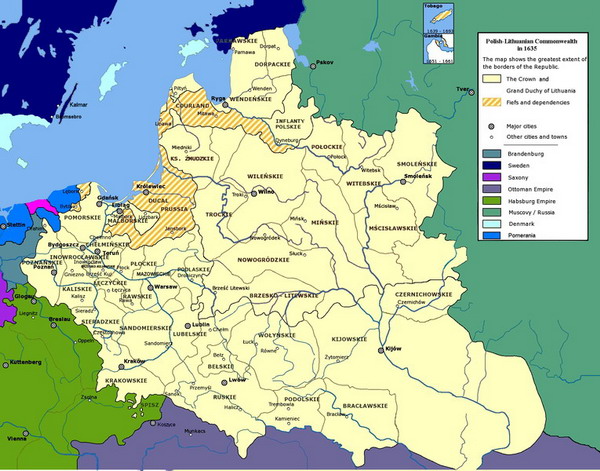
Polish-Lithuanian Commonwealth in 1635.
Some annalistic data were kept about elite of the Volga Bulgaria and Golden Horde. The some people Bulgarian surnames have received even princely titles from Romanov’s, many became well-born noblemen. We shall analyse scanty information and we shall find out an image and modal Haplotype Rurikovich-Horde, and also we shall collect their descendants in one cluster.
On family legend and external factors – surnames, endowments and to metaphysical qualities, the author of the given research ranks itself as descendants of Princes Kubensky’s, branch of Yaroslavl Princes Rurikovich’s, Monomakhish’s. It is officially considered, that sort Kubensky’s has died away in days of Ivan Terrible. However at two brothers Kubensky’s was three sons, the trace which was lost in chronicles of vague time. Prince Ivan Ivanovich Kubensky and Princesses – his mother, the wife, the wife of the brother and the niece – are buried in Smolensk Cathedral Novodevichiy monastery in Moscow that speaks about the highest social status of family.
To Haplotype Kubarev are closest Haplotype Krawczyk (professor from Poland), Uspensky and the descendant of Golden Horde Khan Edigei, colonnel and founder of Nogajskaya Horde.
Edigei and Kubarev-Kubensky are a link between Monomakhish’s and tsars of Volga Bulgaria. In fact on our reconstruction of the history executed by the author in the book Vedas of Russis [13] confirmed Bulgarian the annals Djagfar Taryhi [14], that Rurik (Lachyn) is son of Russ Aydar, as well as his senior brother Djilki is necessary Russ the son Hagan of Russia. While Rurik built own state – the Old Kiev Russia, Djilki has inherited authority above Great Bulgaria, including the Volga Bulgaria. Rurik has based dynasty Rurikovich’s, and Djilki is Saklan dynasty of Bulgarian tsars.
What we know about Edigei?
Edigei, Aidigei or Idigei (Tatarian is Idegay, İdegəy, Bashkirian is Иҙеүкәй, Polish is Edygej), (1352-1419), is colonel Golden Horde at the end of XIV – the beginning of XV centuries. Is the founder of the dynasty which has headed Nogaiskaya Horde. Was the native of tribe Mangut (Mangyt). Is son Baltyrchak, Emir of Mangyt’s. Father and senior brother Isa served Urus-khan, and Idig for the unknown reason, has been compelled to run. Being rescueed from Urus-khan, after young Tohtamysh has arrived to Timur's court yard from which armies began the service. Sister Edigei was wife Tamerlan. By time of campaign Tamerlan against Tohtamysh in 1391 was one of the main emirs of an army. Edigei strongly held authority in Golden Horde, some rise of the international authority and political influence of the breaking up state is connected to his name. This was promoted Timur's by death in 1405 and the begun distempers in Maverannarh. Having taken advantage of it, in 1406 Edigei has managed for some years to grasped Khoresm.
In 1400 Timur–Kutlug has died, and on Golden Horde the throne sat khan Shadibek. Carrying out a life in entertainments Shadibek interfered with a policy a little, and Edigei thus became the absolute master of Golden Horde. In 1419 Edigei has been killed by one of sons Tohtamysh in area of the city of Sarajchik. Notes about character and appearance Edigei were left only by one east author – Ibn Arabshah. It so described Edigei [15]:
« Hi was very swarty [person], average growth, a dense constitution, brave, terrible on a kind, high mind, generous, with a pleasant smile, a neat insight and ingenuity »
The following known person, Haplotype which is in genetic affinity to first group Rurikovich-Horde, he is descendant Simeon Bekbulatovich.
Sain-Bulat steel khan, tsar of All Russia (after christening is Simeon Bekbulatovich, in monk is Stefan, Tatarian Sainbulat, ساین بولاط), has died on January 5, 1616. Simeom the son Bek-Bulat steel of the sultan, the great-grandson of Ahmat-khan, ruled the Big Horde was Kasimov khan in 1567-1573. Together with the father has passed on service to Ivan Basilyevich Terrible. He is participated in Livonian campaigns of 1570th. Within oprichnina Ivan has insisted on call Simeon Grand Prince of All Russia (1575-76) and Grand Prince of Tver (since 1576) though, in effect, descendant Chingishana of political weight had no and remained only the figurehead.
In July 1573 under insisting of Ivan Terrible, Sain-Bulat steel was christened with name Simeom. Has taken in the wife widow Anastasia Cherkasskaya, the daughter of Prince Ivan Fyodorovich Mstislavsky, the former chapter land in the same summer. She was the relative of an imperial surname, in its veins blood of Sofia Paleolog flew. In a marriage at them were six children: three sons – Fyodor, Dimity, John and three daughters: Evdokia, Maria, Anastasia. It were last descendants of Ivan III and Sofia Paleolog, known on written sources. Has died on January 5, 1616 and has been buried near to wife in Simonov monastery. On gravestone there was an inscription: « Summers to 7124 January in 5 day the Christian tsar Simeon Bekbulatovich in monk Stefan has passed away ». Now the tomb of tsar Simeona is lost.
Following known representative Rurikovich’s-Horde’s is descendant Basil Ivanovich Kosoy is Eino Kosonen, it come from Finland. We have to two Haplotype Eino and Ray Kosonen. On family legend Kosonen they have descendants to Basil Ivanovichu Patrikeev (Kosoy – Slanting), Gediminovich. However Gedeminovich’s from another cluster – their modal Haplotype D from the Southern–Baltic branch, and at Kosonen is modal Haplotype E from Finno-Russian group.
We believe that Kosonen descendants of Rurikovich-Horde by a nickname Kosoy (Slanting) from family Sitsky. A possible ancestor called Basil Ivanovich Sitsky (Slanting) which has died in 1608. Fydor Petrovich Sitsky (has died after 1535) had a nickname Kosoy or krivoy (Slanting or Curve). Basil Ivanovich Sitsky – Prince, the son of Prince Ivan Basilievich Sitsky and Efimia Nikitichna Romanova. That for the first time mention in 1601. This year Romanov’s were comprehended with disgrace from Tsar Boris Godunov. Their relatives among, whom Basil's parents were also have suffered also. His father, Ivan Basilievich with the wife and Basil have been brought held down in Moscow from Astrakhan where Prince Ivan Vasilievich Sitsky served before colonel. In a result Prince Ivan Basiljevich Sitsky has been deprived nobility and cut in monk with name Sergiy in Kozeozersky monastery, based Saint Serapion about 1565 and taking place in district Kargopolsky. The wife of it, Efimia Nikitichna, is cut with name Evdokia in desert Sunsk Ostrog on White Lake where has died on April 8, 1602. Basil has not been cut also veins in Kozeozersky monastery or nearby from him. After death of the father in 1608 Basil is caused to Moscow and on road is exterminated.
Part Sitsky carried a surname Kosoy (Slanting). So Basily Andreevich has left 6 sons, and also unmarried daughter Stepanidu (died on January 13, 1591). Senior son Jury Vasiljevich Kosoy is mentioned in categories in 1559/1560 [16]. It is considered, that after 1644 in Russia sort Sitsky has died away.
Thus we recognize that we have for cluster Rurikovich’s-Horde’s L550-only indirect acknowledgement of an accessory of these Haplotype’s to Princes Kubensky, Sitsky-Kosoy (Slanting) and Tsar Bekbulatovich and to khan Edigei. Nevertheless, indirect acknowledgement at their quantity introduces convincing quality to demonstrative base. Prospective is descendants of Princes Kubensky’s and Sitsky’s it Monomakhshich, Rurikovich. Documentary family trees at them are not present. However shortly we shall receive Haplotype Genealogy confirmed Rurikovich’s–Horde’s. Then our assumptions become a conclusive reality.
Actually calculated modal Haplotype Rurikovich-Horde E it Haplotype Monomakhish. The genetic distance from the Monomakh makes at Krawczyk – 4, Kubarev – 6, Edigei – 8, Uspensky – 8, Hoegseth – 13 (in 9 markers), Patrakka – 15 (13) and Bekbulatovich – 16 (13). In any case all Horde’s keep on very close patrimonial trees going from base Haplotype E. Someone from Horde’s descendants of Genghiskhan (1262-1227), someone descendants of Djilki (820-882) and someone descendants of Rurik (822-882) and the Monomakh (1053-1125). With a set of a statistical material we can place more precisely all Haplotype on branches of a patrimonial tree of the Sort of Russ.
Let's make a patrimonial tree of the Sort of Russ Table No. 1 and we shall show on it branches A, B, C, D and E. Time of division modal Haplotypes will lay in some range of dates.
| 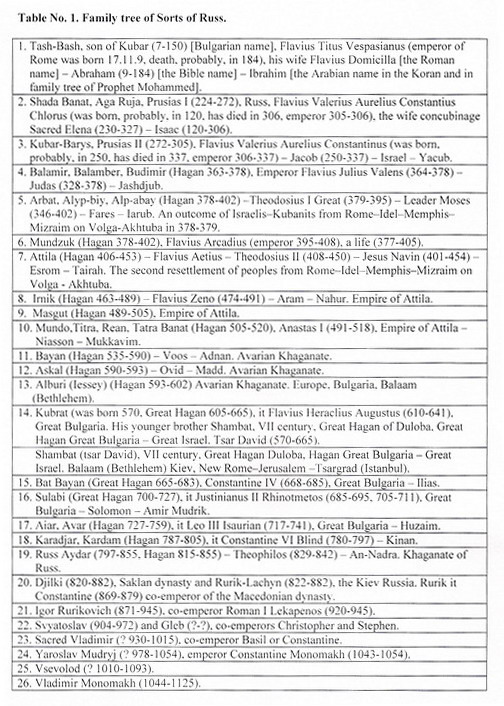
| Haplotype A.
Goes from the representative of the most ancient sort of Russia in our era by name Titus Vespasianus Flavius is the founder of dynasty Flavius. Flavius it is branch Fabius and Heraclius. Take the beginning from Adam [a bible name] or Tarh [an Arias name]. Time of existence Haplotype A is 9-850 of our era. Haplotype B.
It was allocated from the Sort of Russia with 24 on 25 knees (Jaroslav Mudryj, Vsevolod) about 1040.
Cousins Rurikovich from sort Bordjigin’s and Genghiskhan’s. Cluster Mongolian Rurikovich’s. Haplotype C and D.
Were allocated from the Sort of Russia with 14 on 23 knees (Kubrat and Shambat, Bath Bayan, Sulabi, the Avar, Karadjar, Russia Aydar, Rurik, Igor, Svyatoslav and Gleb, Sacred Vladimir) during 600-1000 years. Cousins Rurikovich from Russian Lithuanian sorts Olgerd (Dovmontovich) and Narimunt (Gediminovich’s). Cluster Lithuanian Rurikovich’s. Haplotype E.
It was allocated from the Sort of Russia with 20 on 26 knees (Rurik and Djilki, Igor, Svyatoslav and Gleb, Sacred Vladimir, Jaroslav Mudryj, Vsevolod, Vladimir Monomakh) with 850 for 1100.
Present Rurikovich-Horde’s and Bulgarian Tsars of Saklansky dynasty. Cluster Rurikovich’s-Horde’s. Let's sum up our research in Table № 2 Genetic distances of the Sort of Russ on modal Haplotype. We shall draw the following conclusions: 1. Officially proclaimed Rurikovich from Princes of Russian Empire, included in the Russian Nobiliary Assembly, are descendants Olgerd Dovmontovich, Russian Lithuanian Prince. They have Rurik cousins from Southern–Baltic cluster Sorts of Russ. It Starodub, Smolensk, Chernigov and in part Princes northern grounds: Khilkov’s, Gagarin’s, Vadbolsky’s, Putyatin’s, Shahovskoy’s, Rzhevsky’s, Kropotkin’s, Puzyna’s, etc. SNP L550 +. All their family trees from Rurik are an invention of XIX century.
2. Gediminovich’s it is the branch of Russian Lithuanian Princes going from Gedimin and his son Narimunta. In Russia they referred to Patrikeev’s, it Princes: Golytsin’s, Khovansky’s, Chartoryisky’s, etc. SNP L550 +. They have Rurik cousins.
3. Descendants Olgerd Dovmontovich and Narimunt are Russian Princely sorts. However to Rurikovich they have no direct attitude. They have Rurik cousins.
4. Descendants of other Princely sorts of Russian Lithuanian and Prussian Princes can carry titles of Princes, such as Kartsev’s, Myshetsky’s, etc. All these Princes have Rurik cousins. SNP L550 +.
5. Branch of descendants or cousins of Princes Rurikovich’s are transitive Haplotype, carried us to Central Russian Rurikovich. It Haplotype of Galbraith’s, Vasiliev’s, Shehovtsov’s, Davidsen’s, Zyatev’s, etc.
6. True Rurikovich there is a branch of the Sort of Russia from Finno-Russian cluster Rurikovich’s–Horde’s. SNP L550–.
7. It is necessary to restore the Princely status, position in a society and a history of Russia of descendants of Princes, khans and tsars Rurikovich’s–Horde’s.
8. Representatives of the Russian genealogic society and RNA Stanislav Vladimirovich Dumin and Andrey Nikolaevich Zhuravlyov–Seslavin spread in a science antiRussian, masonic position Polish-Lithuanian Szlachta and Romanov's illegal Imperial House, undermining trust to DNA-Genealogy and the rights of descendants Rurik, Djilki, Genghiskhan, Olgerd and Narimunt.
9. It is necessary to carry out careful research of remains of burial places of Russian Princes temples of the Moscow Kremlin, Novodevichiy monastery in Moscow and others in Russia and Ukraine for final definition modal Haplotype true Rurikovich within the framework of preparation of celebrating of the 1150-anniversary of origin of the Russian statehood which will be marked in 2012.
| 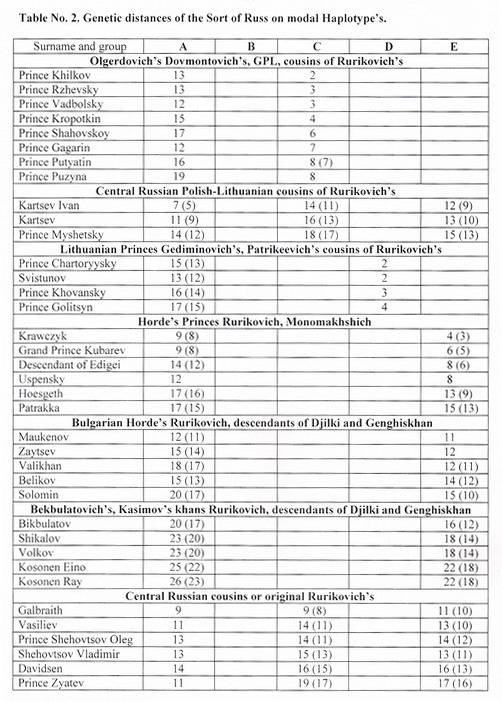
| Grand Prince Valeriy Viktorovich Kubarev Grand Kubensky Rurikovich 19-31.07.2011. The bibliography:
| [1] Rurikid Dynasty DNA Project. Link:
http://www.familytreedna.com/public/rurikid/default.aspx?section=yresults
[2] http://www.familytreedna.com/public/N1c1/default.aspx?section=yresults
[3] http://www.familytreedna.com/public/RussianNobilityDNA/default.aspx?section=yresults
[4] Кубарев В.В., Генеалогия и генетика князей Руси. Доклад на XXI Международной конференции по проблемам цивилизации, Москва, РосНоУ, 25.12.2010.
Link: http://kubarev.ru/en/content/292.htm
[5] Kuczyñski S.M. Ziemie Czernihowsko-siewierskie pod rządami Litwy. Warszawa, 1936.
[6] Власьев Г. А. Потомство Рюрика. СПб., 1906—1917. т. 1, ч. 2, стр. 242 и 243.
[7] Задонщина. Подготовка текста и примечания Л. А. Дмитриева // Изборник (Сборник произведений литературы Древней Руси) / Составители и общие редакторы Л. А. Дмитриев и Д. С. Лихачёв. — Москва: Художественная литература, 1969. — С. 380—397, 747—750 (примечания).
[8] Бобров А. Г. Проблема подлинности «Слова о полку Игореве» и Ефросин Белоозёрский // Acta Slavica Iaponica — T. 22, 2005. — p. 252
[9] Насевіч В. Міндоўг // Вялікае Княства Літоўскае. Энцыклапедыя у 3 т. — Мн.: Беларуская Энцыклапедыя імя П. Броўкі, 2005. — Т. 2: Кадэцкі корпус — Яцкевіч. — С. 312—313. — 788 с.
[10] Кубарев В.В., Генетические дистанции кузенов Рюриковичей. Доклад на XXII Международной конференции по проблемам цивилизации, Москва, РосНоУ, 22-23.04.2011. Link: http://www.kubarev.ru/en/content/301.htm
[11] Livländische Reimchronik // SRL. Bd.1. Riga und Leipzig, 1853.
[12] Татарские ярлыки литовским великим князьям, link:
http://litopys.org.ua/rizne/spysok/spys.htm
[13] Кубарев В.В., Веды Руси, М., IP Media, Inc. 2009. Link:
http://www.kubarev.ru/en/content/251.htm
[14] Бахши Иман, Джагфар Тарыхи (Летописи Джагфара) Гази-Барадж Тарыхи (Летопись Гази-Бараджа), I – III том.
[15] Греков Б. Д., Якубовский А. Ю. Золотая Орда и её падение. — М.-Л., 1950.
[16] Кобрин В. Б. Материалы генеалогии княжеско-боярской аристократии XV—XVI вв. — С. 64—65.
| Text of article in Word:
 7661.doc 7661.doc |
|